Lent’s CRS Lent Rice Bowl collection critical after USAID cuts
“Are you leaving, too?”
The question, said Abena Amedormey — country representative for Catholic Relief Services in the west African nation of Ghana — came to CRS workers as they visited communities they serve after a January 2025 freeze on all U.S. foreign aid, ordered by the Trump administration.
By July 2025, the U.S. Agency for International Development — established in 1961, and which in 2024 provided $187 million in humanitarian funding to Ghana — effectively ceased to exist, with 85% of its programs cut. The result was that many in-country aid organizations also ceased operations.
But not CRS.
They’re surviving, yet the deep slashes to USAID funding have now made their annual Rice Bowl collection more essential than ever.
Helping the most vulnerable
A familiar Lenten program of Catholic Relief Services, the official relief and development agency of the Catholic Church in the U.S., CRS Rice Bowl offers faith communities in every diocese throughout the United States the opportunity to put their faith into action.
Since 1975, the titular rice bowl — a brightly colored, cardboard almsgiving box that’s a familiar annual Lenten sight in parishes nationwide — has invited Catholics to pray, fast, and give in solidarity with the world’s poor.
“We’re very much known across Ghana,” Amedormey told OSV News. “People know that we bring relief and we work with the most vulnerable people, where nobody wants to go. It’s the remotest parts of the country — the most hard to reach areas; the most vulnerable people — that we work with.”
Present in the country from 1958 onwards, Catholic Relief Services Ghana works to tackle poverty with a holistic approach, operating projects to improve child and maternal health, increase access to clean water and sanitation, scale up farm production, and enhance community-level savings and lending.
“We strongly believe in sustainability — because we don’t want to come in, support you and then we’re gone,” said Amedormey. “It’s like the saying, ‘Teach a man to fish.’ We don’t want to provide fish and leave. We want them to go out to fish.”
A mission under threat
With the shuttering of USAID, that mission is threatened.
“The (Ghanian) government suffered a huge shortfall of financing in the health sector,” shared Amedormey, “and this was also in education, where there were school feeding programs and teacher training programs.”
Those additional disruptions struck the work of other non-governmental organizations.
“A lot of organizations had to close shop overnight, had to lay off people, had to stop programming. These layoffs affected health care workers, agriculture extension officers, social workers, and administrative staff,” Amedormey said. “And so, names and faces that were known in a lot of communities as bringing support, overnight had to pack up and leave.”
Farmers lost subsidized fertilizer, improved seeds, and training, which had all aimed to increase their crop yields.
Specialized teacher training was suspended, and children who looked forward to school meals could no longer be sure they’d have them.
All of it, said Amedormey, “had a huge impact.”
However, she remains committedly optimistic.
“One of the things that CRS has been faithful to is trying as much as possible to fill the gaps,” she said.
Solidarity amid grim statistics
The Lancet, a peer-reviewed British medical journal published since 1823, estimated USAID assistance has saved more than 91 million lives, including that of 30 million children, over the past two decades.
The journal’s July 2025 prediction, however, was grim.
“Our estimates show that, unless the abrupt funding cuts announced and implemented in the first half of 2025 are reversed, a staggering number of avoidable deaths could occur by 2030,” the Lancet forecast. The study noted that almost 14.1 million people could die by that year, with over 4.5 million deaths being children younger than 5.
“It’s even more important than ever that Catholics take seriously that call to live Lent,” Knobbe said. “CRS Rice Bowl gives people a chance to truly grow in solidarity with our global neighbors through their prayer, fasting, and almsgiving.
Some 11,000 Catholic parishes and schools will participate in 2026, Knobbe said.
To learn more about the CRS Rice Bowl program, click HERE.
This article was written by Kimberley Heatherington for OSV News.
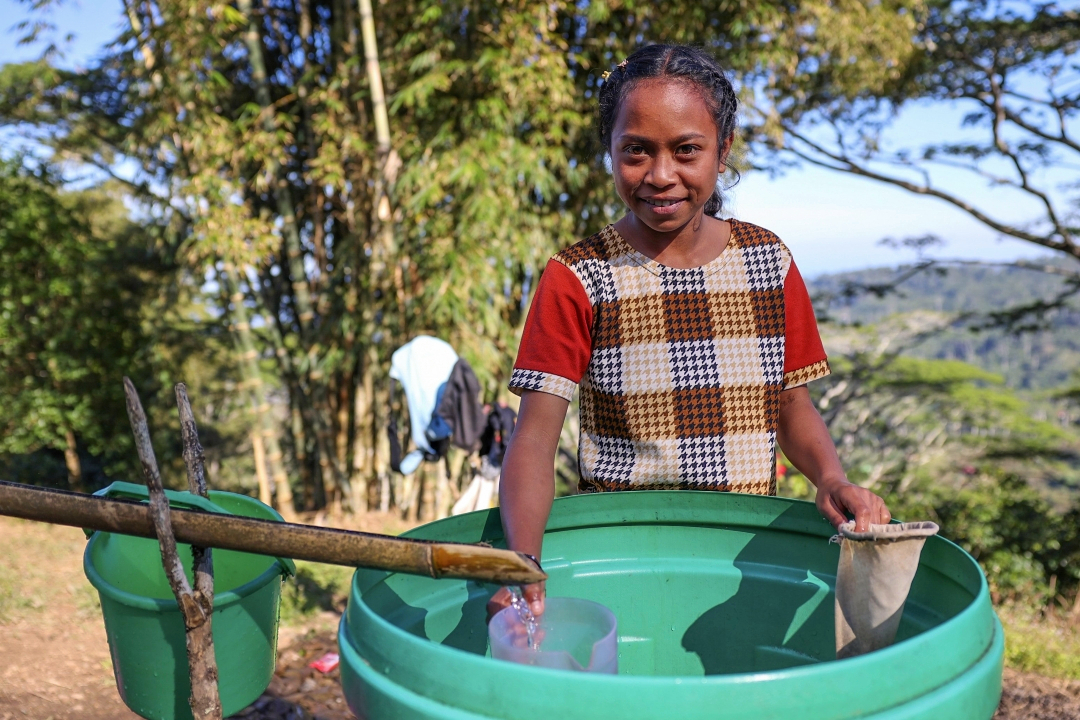
Featured image: Adriana, 14, of Timor-Leste, is pictured in a July 5, 2024, doing daily chores, such as collecting water for her family. Catholic Relief Services supported nutrition and health initiatives for adolescent girls and young women across 21 communities in Timor-Leste. (OSV News photo/Benny Manser, Catholic Relief Services)