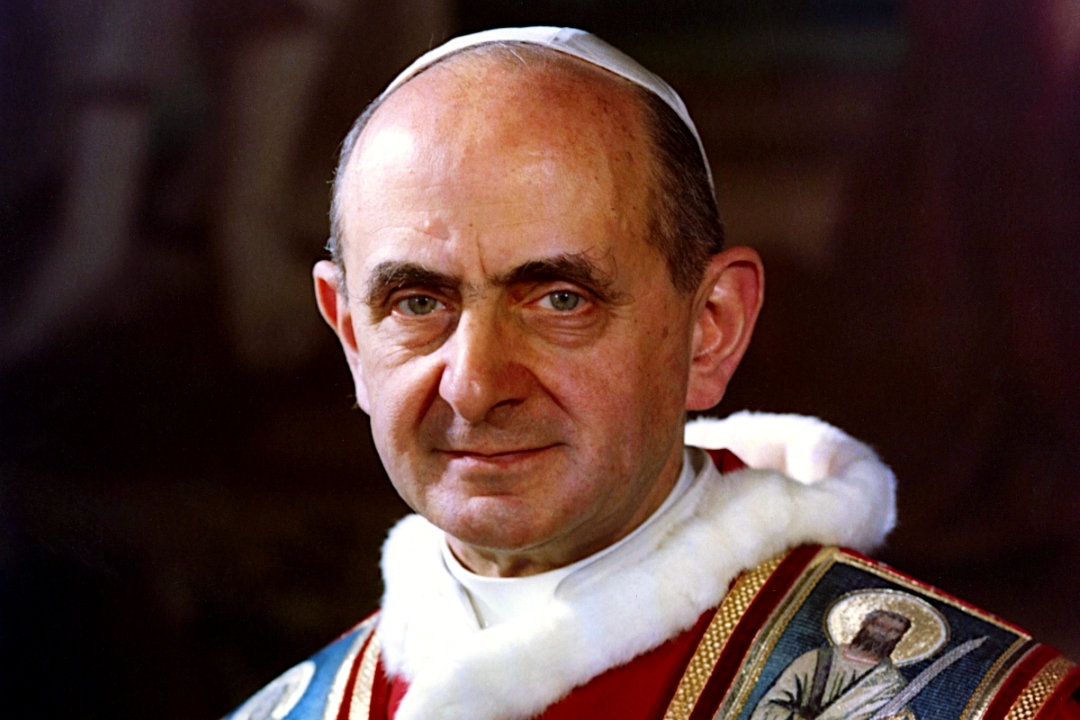
Saint Paul VI still has much to say to us
May 29, the feast of Saint Paul VI, is an appropriate time to reflect not just on the impact of his pontificate on the Catholic Church, but on three aspects of his life and spirituality that continue to teach and inspire Catholics and all people of good will.
Hearer of the cry of the poor
Per longstanding tradition, when Paul VI was made Pope, he was crowned with a three-tiered golden tiara. Over the course of the next year and a half, the question of world poverty came up repeatedly at the Second Vatican Council, with many Fathers of the Council urging the Church to forgo all shows of pomp and to embrace poverty with more vigor. Moved by these pleas, Paul VI made a dramatic gesture, as described in a New York Times article at the time:
“At the close of a solemn liturgical Mass in the Byzantine-Slavic Rite, the Pope rose from his throne, descended a few steps and placed the gleaming tiara on the altar.”
Though Paul VI had no personal love for ornate displays, that tiara had been a gift of the Catholics of his old diocese, Milan. For this reason, it no doubt had sentimental value to him. Nevertheless, it was announced that Pope Paul VI would donate the tiara to benefit the poor of the world. That would also be the last time a crown was worn by a pope.
Donations from Catholics in the United States brought Paul VI’s tiara to Washington, DC. It can now be viewed at the Basilica of the National Shrine of the Immaculate Conception and serves as a reminder that like Paul VI, all Christians are called to hear the cry of the poor and to make personal sacrifices to provide for them.
Friend of the unborn
After his death, the author of Humanae Vitae remained a staunch friend of the most vulnerable, the unborn. In fact, both miracles that led to St. Paul VI’s canonization involved unborn babies whose mothers were advised to seek abortions.
One baby was gravely ill and at risk of brain damage, the other appeared to be disabled. Doctors had insisted there was no hope for either child, but in both cases, their mothers had prayed for Paul VI’s intercession. When both babies were born healthy, doctors had no explanations.
It is easy to forget or ignore those who are out of our sight. That St. Paul VI seems to have a special preference for the unborn serves as an admonition that when we ignore the most vulnerable members of the human family, we also ignore God. May those who are “invisible,” particularly unborn children, remain as precious to us as they are to the “saint of the unborn.”
Prophet of peace
On October 4, 1965, Paul VI became the first pope to address the United Nations on its 20th anniversary. His speech, delivered at the height of the Cold War, was a plea that all nations turn away from war and instead engage in dialogue and seek peaceful coexistence.
In his speech, Paul VI said that he was speaking “for the dead as well as the living: for the dead who have fallen in the terrible wars of the past, dreaming of world peace and harmony; for the living who have survived the wars and who in their hearts condemn in advance those who would try to have them repeated …”
Referring to the example of Christ, Paul VI declared:
“It is impossible for someone to be a brother if he is not humble. For it is pride, as inevitable as it may seem, that provokes the tensions and struggles over prestige, over domination, over colonialism, over selfishness. It is pride that shatters brotherhood.
Here our message reaches its culmination and we will speak first of all negatively. These are the words you are looking for us to say and the words we cannot utter without feeling aware of their seriousness and solemnity: never again one against the other, never, never again!”
In his speech, Paul VI made clear that his message was not intended exclusively for the delegates in the General Assembly but was directed to all people of every time. In a world rife with arrogance, violence, and hatred, he continues to remind the world that there can be no real peace without humility.
June 21 will mark 63 years since the Archbishop of Milan, Cardinal Giovanni Battista Montini was elected Pope Paul VI. Though the world has gone through dramatic transformations in the last six decades, this humble saint still has much to teach us.
This article was written by John Touhey for Aleteia and was originally published on June 21, 2023. It has been modified by the author for its republication on Jersey Catholic.
Featured image: Portrait of Pope Paul VI by Fotografia Felici, 1969 (Wikimedia Commons / Public Domain)