Memorial Day services witness to promise of the Resurrection
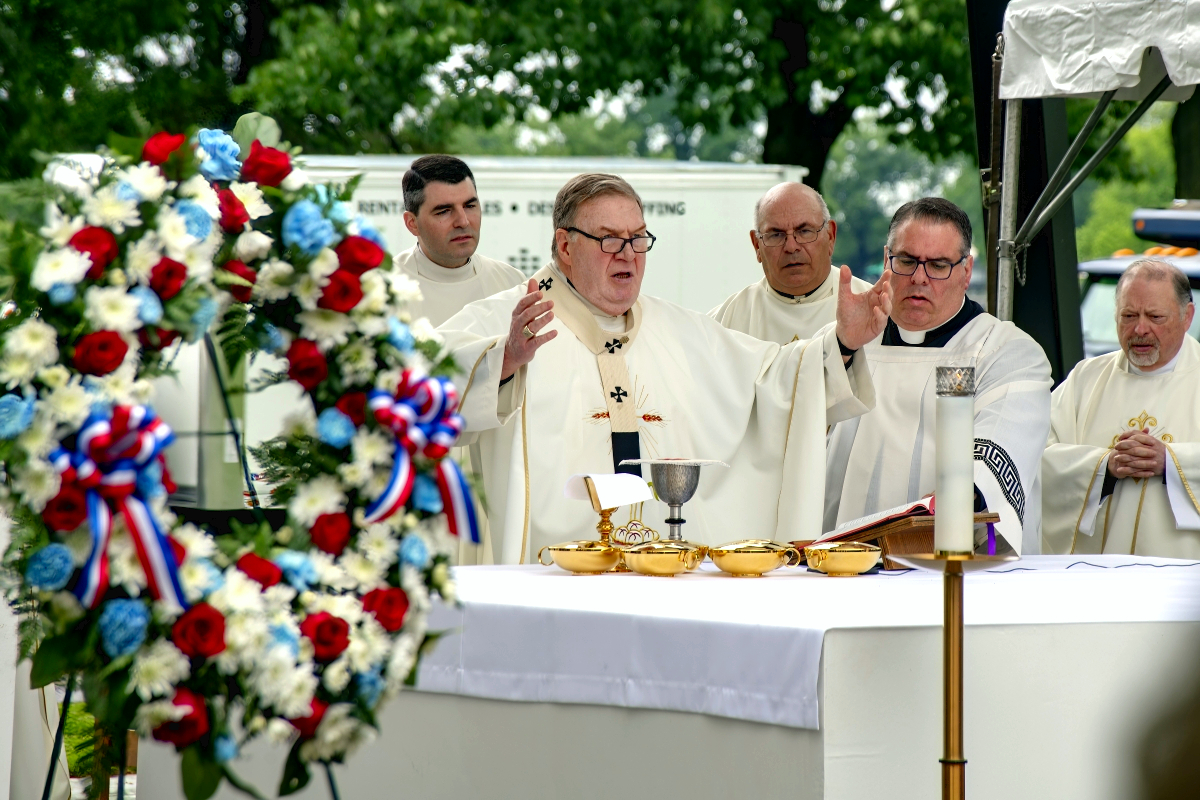
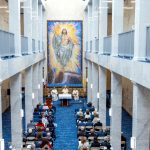
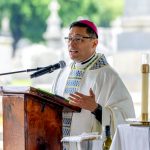
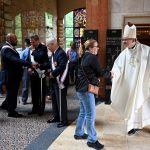
On May 25, amid overcast skies, worshippers arrived at Holy Cross Cemetery in North Arlington, NJ, to remember fallen heroes at a liturgy celebrated by Cardinal Joseph W. Tobin, C.Ss.R., Archbishop of Newark.
It seemed at first that the inclement weather might result in a sparse turnout. As the Mass got underway, however, the rows of worshippers began to swell, and hundreds soon stood shoulder to shoulder. It was a striking tribute to a community that refused to let the sacrifice of its heroes go unnoticed.
Identical Masses were simultaneously being celebrated at five other archdiocesan locations: Gate of Heaven Cemetery in East Hanover, with Bishop Manuel A. Cruz; St. Gertrude Cemetery in Colonia, with Bishop Elias R. Lorenzo, O.S.B.; Maryrest Cemetery in Mahwah, with Bishop Michael A. Saporito; Christ the King Cemetery in Franklin Lakes, with Father John J. Chadwick, Vicar General of the Archdiocese of Newark; and Holy Name Cemetery in Jersey City, where Bishop Pedro Bismarck Chau served as main celebrant for the first time since his 2025 ordination.
The annual tradition carried a unique historical resonance this year, aligning with the national celebration of the 250th anniversary of the United States’ founding.
Standing together at the foot of the cross
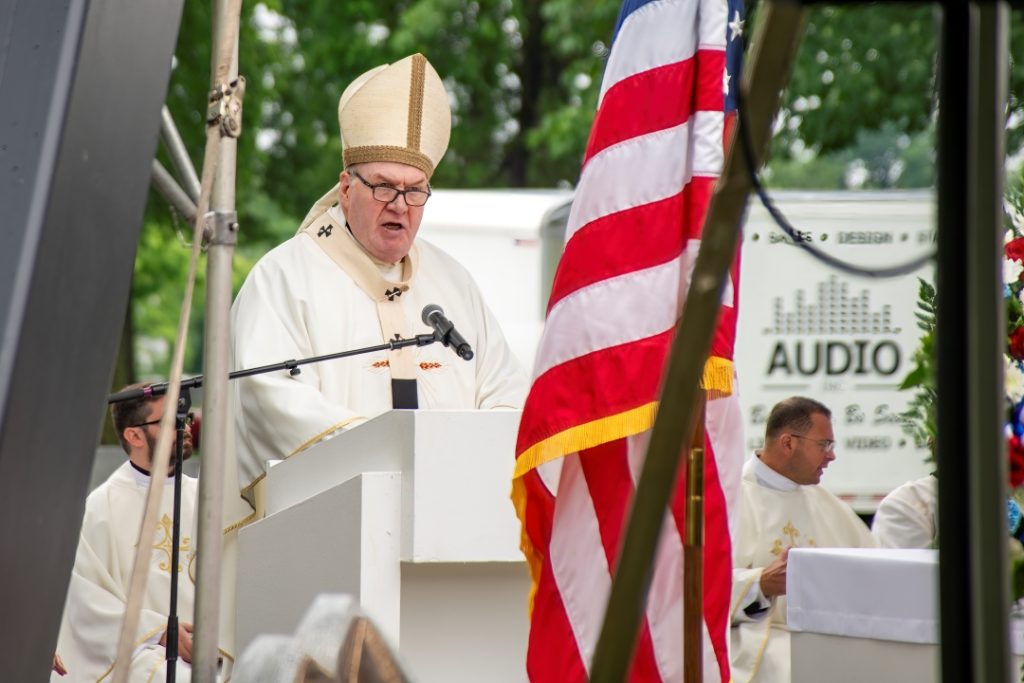
In his homily, Cardinal Tobin described the cemetery as a “cathedral of memory and gratitude.”
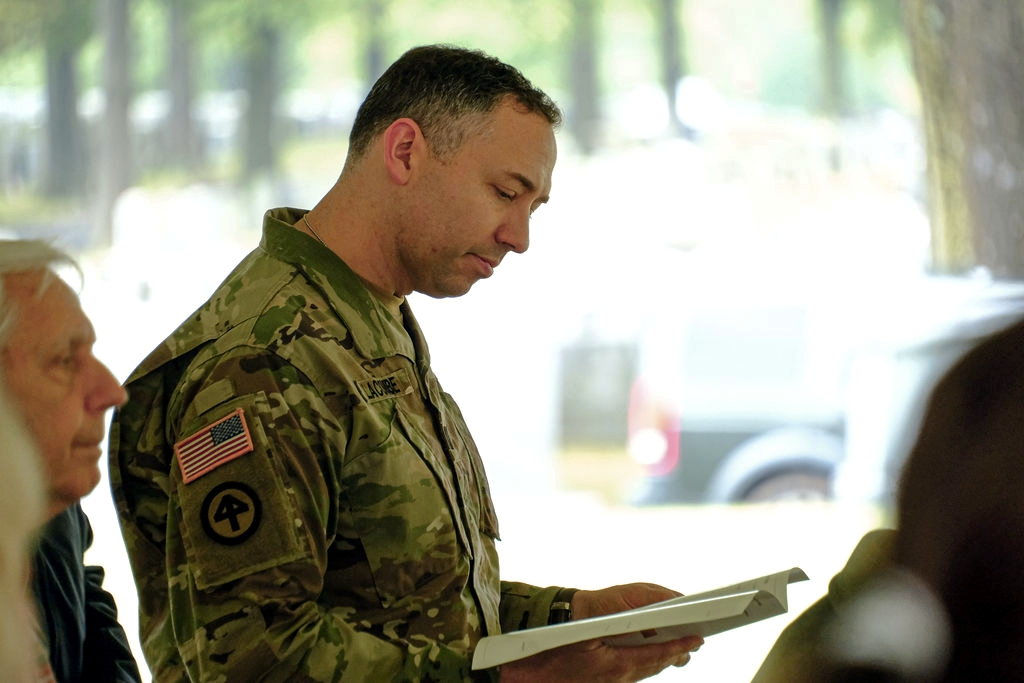
“We stand surrounded by the silent, solemn rows of those who answered our nation’s call, who wore a uniform, who laid down their lives on the altar of freedom,” Cardinal Tobin told veterans, their family members, and others who came to honor those who made the ultimate sacrifice. “The quiet of these graves, nevertheless, speaks eloquently. It is a testimony of courage, of duty, of families fractured by loss, and of a love for country that was tested, even unto death.”
The cardinal referred to the day’s Gospel reading (John 19:25-34), in which the Blessed Virgin Mary, Mary Magdalene, and John stand on the hill of Calvary in the shadow of unspeakable human suffering.
“Every family member who has ever received a folded flag, every mother who has ever wept for a child lost in battle, stands in spirit with Mary at the foot of the cross,” he said. “Yet, even in the agony of execution, Christ built community from the cross, binding His mother and His beloved disciple together. He is ensuring that those who are left behind are not left alone. This is our first calling today: to stand together, to support the families of our fallen, and to ensure that their sacrifice is never forgotten by a self-occupied world.”
Gratitude and prayer
Cardinal Tobin noted how the early Church returned to the Upper Room after the Ascension of Jesus, not scattering in despair but praying in one accord.
“As Catholics, we do not view a cemetery as a place of final defeat,” Cardinal Tobin emphasized. “We do not look at these headstones as monuments to hopelessness. A Catholic cemetery is a dormitory, a place of rest.”
He reminded the faithful not only of their civic obligation of expressing gratitude toward those who paid the price for the freedom that others enjoy today, but of their spiritual obligation to pray for the deceased. “We do not just remember them,” the cardinal said. “We pray for them. We offer this holy sacrifice of the Mass for the repose of their souls… so that they may be welcomed into the kingdom where there is no more war, no more pain.”
A legacy of presence
Following the liturgy, Cardinal Tobin reflected on the nation’s 250th anniversary and of the part that Catholic military chaplaincy has played in that history, which stretches from the battlefields of the Revolutionary and Civil Wars to the conflicts of the 20th and 21st centuries worldwide. During wartime, priests have consistently stepped into harm’s way to celebrate Mass, anoint the sick, and perform final rites.
For Cardinal Tobin, this legacy is deeply personal.
“I have a personal relationship with a couple of chaplains,” the Cardinal shared. “One was Father Egidius Smulders. He was an immigrant who served as a Civil War chaplain and later founded the parish where I was baptized in Detroit. Another was Father Harry Smith, a Redemptorist. He served as a Marine Corps chaplain in the South Pacific and later officiated my parents’ wedding. From both a faith standpoint and a human standpoint, I am here with the help of chaplains.”
This lifelong availability, he noted, reflects the core of the Catholic priesthood.
“It’s the nature of the priesthood to be close to people, to walk with them – as Pope Francis said, ‘to smell like the sheep,’” Cardinal Tobin said. “Especially in moments of great danger or stress, chaplains have given their lives alongside members of the armed forces. They are driven by the example of Jesus Christ, whose greatest love was to lay down his life for his friends.”
The cardinal’s own family mirrors this multi-generational devotion. His father was a disabled veteran of World War II. He currently has a nephew serving in the Demilitarized Zone (DMZ) in Korea. He also has numerous relatives spanning almost every branch of the military.
Witness to the resurrection
Cardinal Tobin also reflected on how Catholic cemeteries embody the Church’s collective witness to the resurrection. He recalled his frequent visits to the ancient Roman catacombs.
“I was taught early on that you could distinguish a Catholic cemetery from a non-Catholic one by the words used to describe it. In Greek, ancient pagan burial grounds were called necropolis—‘cities of the dead.’ But Catholics used the word cemetery (from the Greek word koimeterion), meaning “place of sleep,” the cardinal said.
In a culture that often trivializes death, the Cardinal added that Catholic cemeteries offer an essential countercultural witness.
“It’s vital to keep giving collective witness, especially when people might be drawn to unusual ways of treating loved ones’ remains.”
Spaces of beauty and hope
Joseph Heckel, executive director of Catholic Cemeteries of the Archdiocese of Newark and the national president of the Catholic Cemeteries Conference, also addressed the gathering.
“Together, we honor the men and women who gave their lives defending our nation,” Heckel said. He invited veterans to stand and be recognized with applause. “We also remember those we’ve lost — our everyday heroes who made our lives special,” he continued. “We carry their memory in our hearts until we are united again.”
Before offering his final blessing, Cardinal Tobin publicly thanked Heckel and his vast grounds crew for maintaining the archdiocesan cemeteries as spaces of transcendent beauty. “Beauty is one of the things that raises the question of the Beautiful One — the God who made us,” the Cardinal said. He noted that Newark’s ministry frequently serves as a national benchmark for other dioceses across the country.
He also expressed gratitude to his concelebrant, Reverend Michael Barone, the Chaplain of Holy Cross Cemetery, and to all diocesan priests who accompany families through some of the darkest hours of their lives.
When the final blessing concluded and the faithful began to depart the cemetery, the sun emerged from heavy clouds, yet another moment of beauty that bore witness to Christian hope.
To learn more about Catholic Cemeteries of the Archdiocese of Newark, visit www.rcancem.org.
CLICK HERE to view more photos from Memorial Day Masses held at Catholic cemeteries across the Archdiocese of Newark.
Featured image: Cardinal Joseph W. Tobin, C.Ss.R., Archbishop of Newark celebrated a Memorial Day Mass at Holy Cross Cemetery in North Arlington, NJ, on May 25, 2026. (Photo by Rick Tracy)