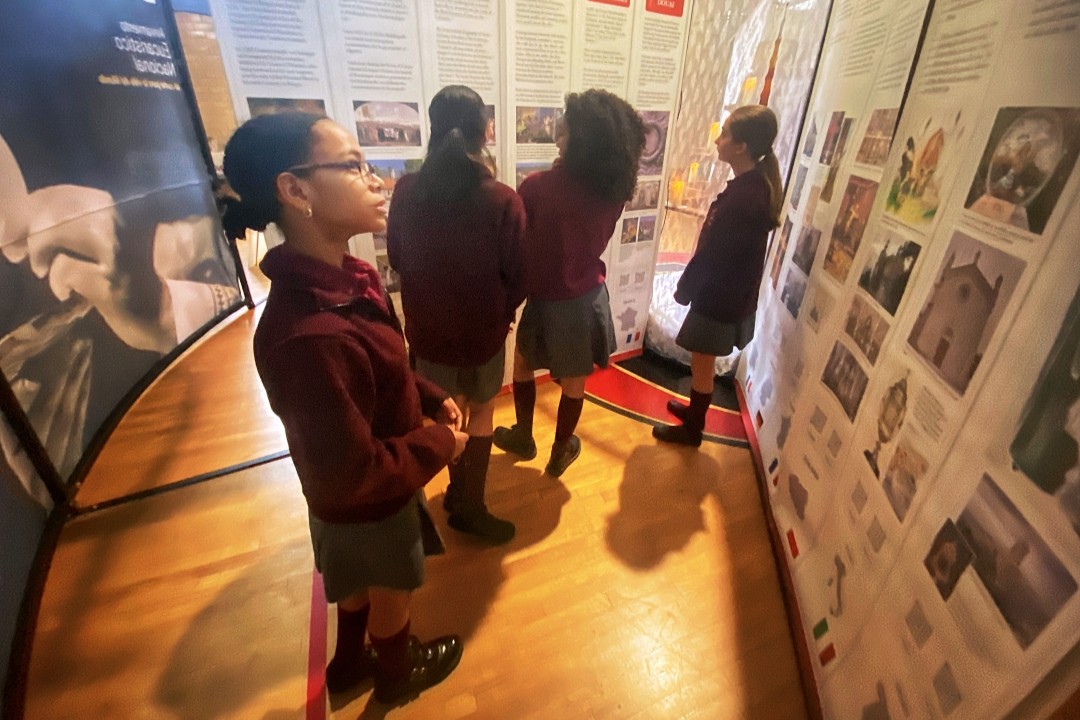
Parish displays Eucharistic miracles exhibit created by St. Carlo Acutis
On November 30,1433, a great flood threatened the city of Avignon in France. Alarmed by the swiftly rising waters, two Franciscan friars took a boat to the small Church of the Holy Cross, where the Blessed Sacrament had been set out on the altar for perpetual adoration. When they arrived at the church, the friars were shocked to discover that, just as the Red Sea had parted before the outstretched hands of Moses, so the floodwaters had divided in two before the Body of Christ.
The Miracle of Avignon is just one of 65 amazing miracles on display at an exhibit sponsored by St. Peter the Apostle Parish in River Edge, NJ, through Sunday, April 12.
The exhibit was originally compiled by Saint Carlo Acutis, the tech-savvy Italian teen who catalogued over 100 Eucharistic miracles on a website that he created before his death from leukemia in 2006. The miracles that St. Carlo documented all involve supernatural phenomena associated with consecrated hosts and wine, from the third century A.D. to 2013.
An amazing healing
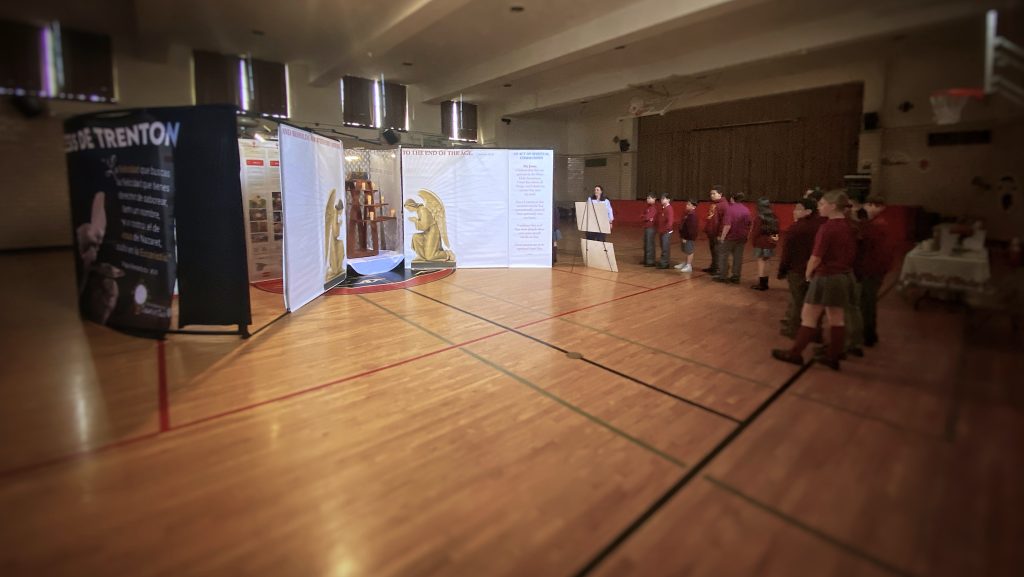
On Wednesday, students from Saint Peter’s Academy were given a sneak preview of the exhibit the day before it opened to the public. As they read the panels, the students pointed and smiled, whispering to each other as they encountered one strange and extraordinary event after another.
They learned about miracles when consecrated hosts dripped blood or displayed miraculous images of Christ, and how the Blessed Sacrament has survived not only floods, but fires, earthquakes, tsunamis, and attacks by impious souls.
Marco, a seventh grader at St. Peter’s, was moved by the story of a boy who was healed after receiving Holy Communion at a Mass in La Rochelle, France, in 1461. “I think it is incredible how a paralyzed and mute child was healed by our Lord,” Marco said. He was also impressed by how the records of the miracle have been preserved in the city’s cathedral for hundreds of years.
“Totally suprising”
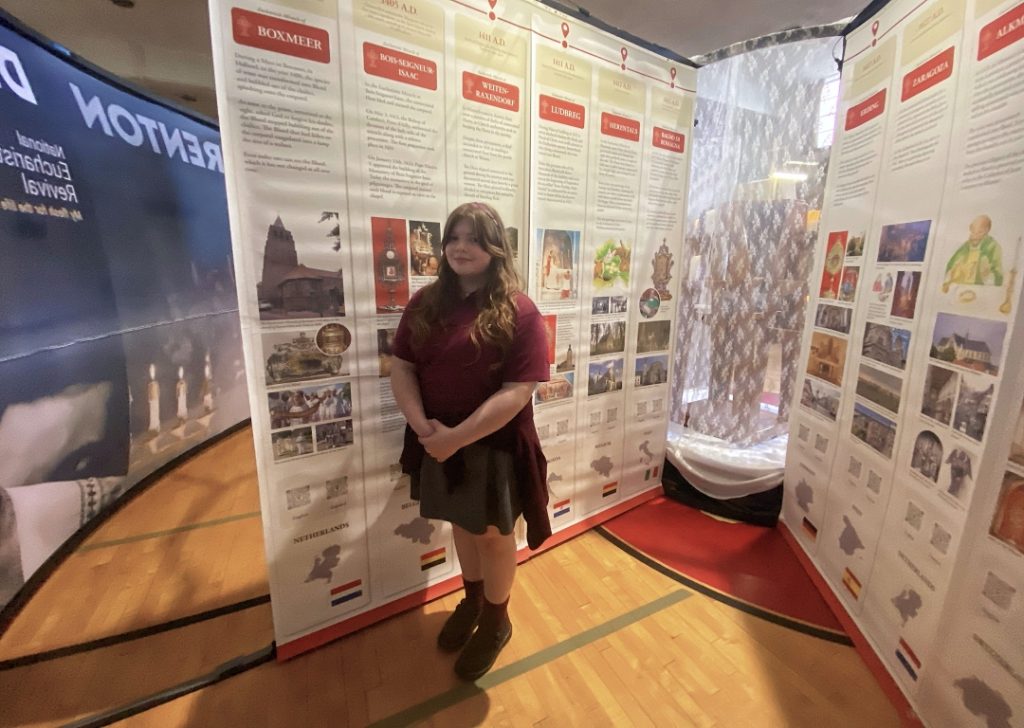
Another student, Samantha, said she was especially moved by a miracle that occurred in the Netherlands in 1400. After reciting the Eucharistic Prayer, a priest in the town of Boxmeer suddenly felt experienced doubts about whether Christ was truly present in the Eucharist. What happened next was shocking, as the panel explains:
… the species of wine was transformed into Blood and bubbled out of the chalice, splashing onto the corporal.”
The Blood solidified after the priest expressed contrition and can still be seen and venerated today.
“I find it really interesting how the priest got scared, but he asked for forgiveness, and then the blood stopped coming out of the chalice,” Samantha, who is in eighth grade, said. “He had doubts, but God forgave him.”
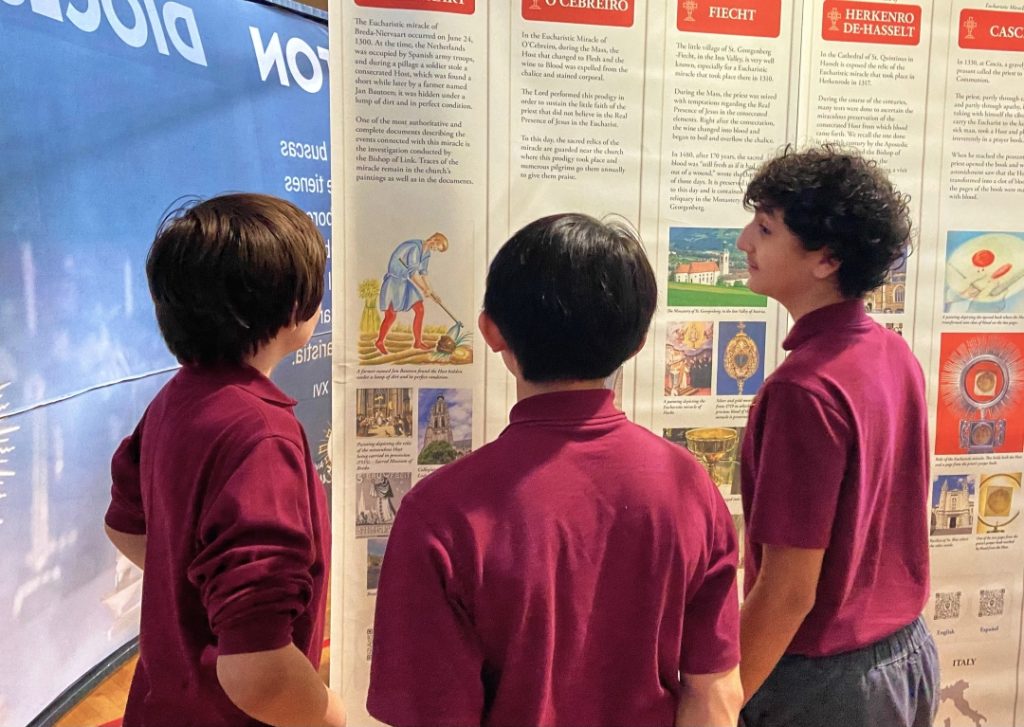
For William, a seventh grader, what makes miracles so great is that they are “totally surprising, not planned.” In 1300, for instance, a Spanish soldier stole a consecrated host, which he buried in a field. It was soon discovered by a farmer named Jan Bautoen.
“Out of nowhere, under a lump of dirt, there it was—poof!” said William. “That’s pretty cool!”
Visitors to the village of Niervaart in the Netherlands can still find the preserved Host in the Collegiate Church of Our Lady of Breda, where it is displayed during processions and public prayers.
Along with photos of the church, there are artists’ depictions of the miracle shown on the panel. William and his classmates said they loved how the wide variety of images helped bring the different stories to life and made them easier to grasp.
Hopeful signs among the young
Exhibits based on St. Carlo Acutis’ work have been presented at thousands of parishes across five continents. The experience at St. Peter’s was designed by the Diocese of Trenton, which has toured the exhibit nationally since 2022 as part of the Catholic Church’s ongoing Eucharistic Revival. To have such an exhibit available to view during Holy Week and the beginning of the Easter season is a special opportunity, however.
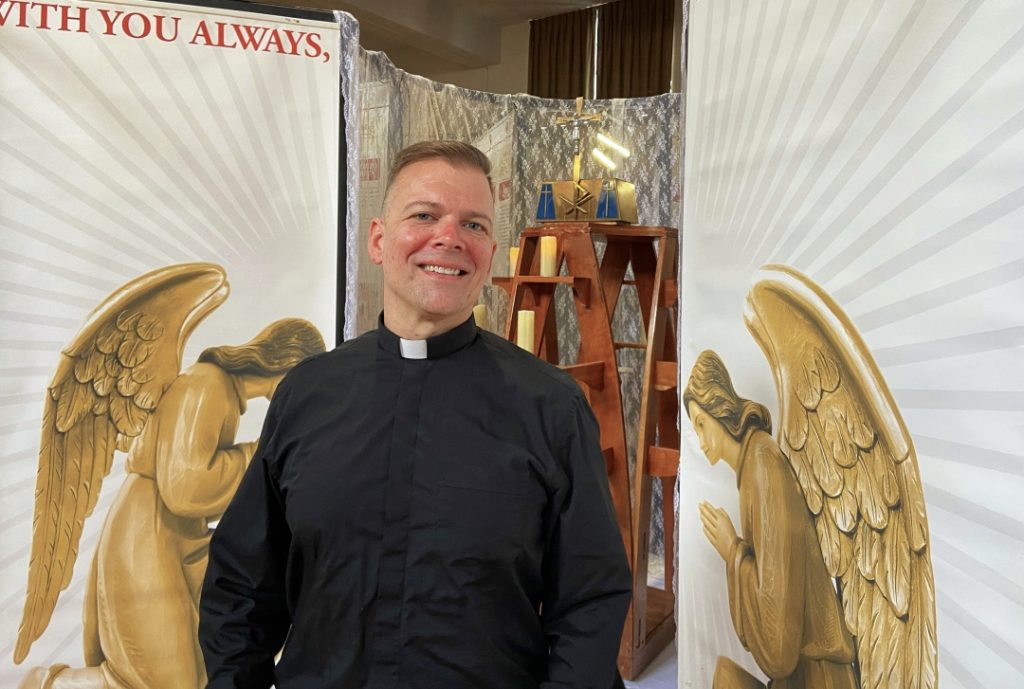
“This exhibit is a blessing because it gives visitors the opportunity to deepen their faith by learning about the love God gives us through the Eucharist and the many miracles that have resulted from it,” said Father Andrew J. DeSilva, pastor of St. Peter’s. “The fact that we’re hosting this experience during Holy Week makes it even more impactful.”
The experience was arranged by the parish’s New Evangelization Ministry, which seeks to bring people closer to Christ by teaching them about examples of his impact through the Eucharist. Organizers also hope that visitors—especially youth—will feel inspired by St. Carlo Acutis after experiencing the young saint’s work.
Asked if he is seeing evidence of a Catholic revival among young people, Father DeSilva points to the increasing numbers of young people actively participating in parish life, especially high school students. “Half the people involved in faith formation in our parish are in high school,” he said. “We have teens who are ushers and a high school-age Bible study that they run on their own.”
“So, yes, we are seeing a huge explosion of young people who are interested in their faith and drawn by Christ into His Church,” he said. “That’s a huge, hopeful sign.”
For more information about the exhibit, including visiting times and wheelchair accessibility information, visit the parish’s exhibit website.
To view more images of the Eucharistic Miracles Exhibit, click HERE.
Featured image: Students from Saint Peter’s Academy visit the Eucharistic miracles exhibit sponsored by St. Peter the Apostle Parish in River Edge, NJ, from now through April 12. (Photos by John Touhey / Archdiocese of Newark)