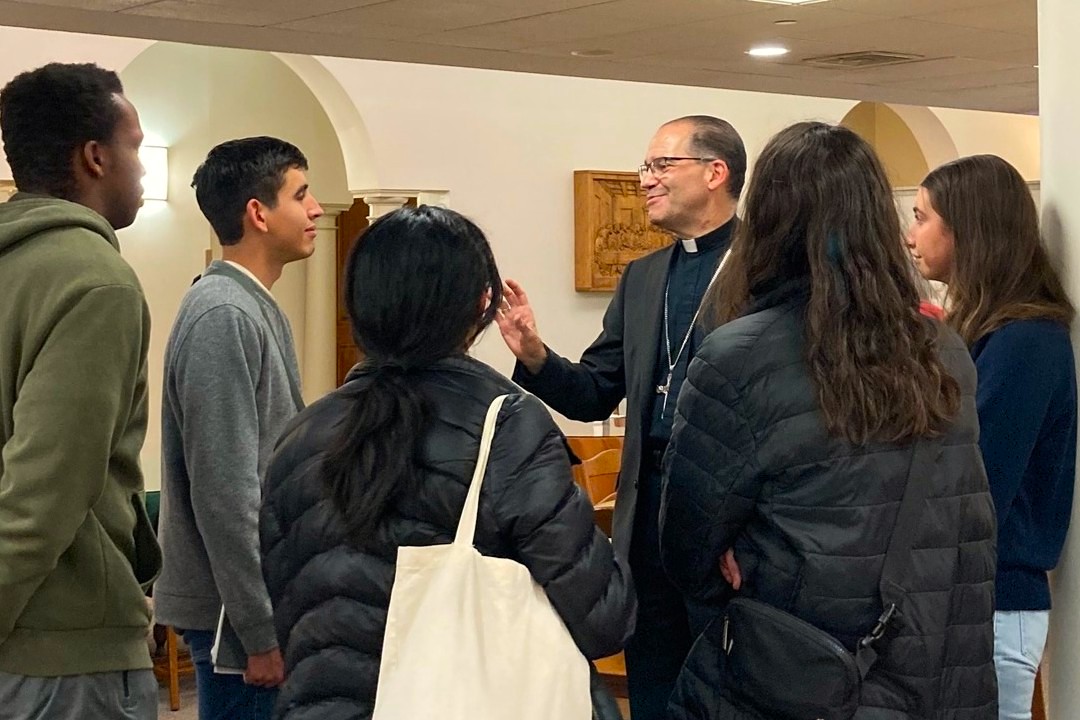
Bishop Saporito on becoming a Christian witness
In August, the man tasked with leading the Archdiocese of Newark’s We Are His Witnesses initiative told Jersey Catholic that its purpose was to “strengthen the mission of the Church.”
Auxiliary Bishop Michael A. Saporito also explained why the archdiocese was acting now. “When we look at the data, it’s clear that the current model is unsustainable,” he said.
Trained as an accountant, the bishop is not one to shy away from statistics – even when they reveal a downturn in Mass attendance while the number of priests in the archdiocese is also declining.
Despite these challenges, Bishop Saporito said that we can “face reality with hope – and prepare intentionally for the future. If we do that, we may help slow or reverse the decline.”
Bishop Saporito’s confidence is based on personal experience.
Unlocking lives and hearts
“Sharing our faith can make us really uncomfortable at times,” Bishop Saporito said. “I think back to the moment I first opened my heart up to Christ when I was 17 and went away on a retreat weekend.” He smiled at the memory. “I was Catholic all my life, but something clicked there, and my faith suddenly came alive for me.”
“I was a super-introvert at the time, though,” he added. “I told myself, ‘I’m not going to share this with anybody.’ But then I surprised myself, and I was inspired to stand up in front of everyone and talk about my experience!”
The episode changed him. “I knew faith was real,” he said. “And since then, I’ve always been looking for ways to unlock that experience of faith in other people’s lives and hearts.”
In search of a spiritual boost
After his ordination to the priesthood in 1992, Bishop Saporito served as a parochial vicar at four parishes in the archdiocese before being appointed pastor of Saint Joseph Parish in Maplewood in 2004 and Saint Helen’s Parish in Westfield in 2011. Those assignments reinforced his conviction that the Church faced genuine challenges in carrying out its mission that required new ideas and models.
“The communities I led understood that we needed a spiritual boost,” Bishop Saporito said. “I couldn’t necessarily provide any answers, but I had my antenna up.” He explored how other parishes were responding to changing circumstances.
During his research, he discovered Catholic communities, such as the Church of the Nativity in Timonium, Maryland, that were experimenting with new outreach methods, sometimes inspired by nondenominational churches. “The important thing for me was to understand why they were trying these things. I appreciated the fact that they were tired of doing the same old thing and were searching for answers, because they understood the old model wasn’t working.”
A need for new models
“I grew up in a model of Church that formed after the Second Vatican Council,” Bishop Saporito explained. “The idea was to reach out to the laity and get them involved. A good parish produced many different ministries and got many people involved. That really worked for a time — until it didn’t anymore.”
He points to Saint Helen’s as a prime example:
“The parish was born during a time of explosive growth. It was a community that went from a few hundred families to thousands of families. Shortly after I became pastor, however, I learned that we had the highest number of registered families since the parish was founded in the early 70s — but also the lowest level of Mass attendance.”
“I knew we couldn’t just let that be,” Bishop Saporito said.
Digging deeper, he saw that the center of parish growth had been a retreat ministry that had “really stirred hearts and inspired people to become involved.” He found that retreats were no longer working, however. “They weren’t attracting any new people. The thing that was driving the community’s growth wasn’t driving it anymore.”
His response was simple: “I started grasping for straws!” Bishop Saporito said with a laugh.
Opening minds and stirring hearts
“By this time, I knew that there were no easy answers,” he explained, but his research of innovative parishes and new learning platforms led him to specific approaches “that opened up my mind and stirred my heart.”
“And I just brought these ideas back to Saint Helen’s, gathered people together, and we started talking about them and trying some of them,” he said.
“Sometimes you also realize you have to change longstanding things you have been doing,” the bishop added. “We saw we were too spread out and needed to prune some of our ministries. That forced us to decide which efforts had a real impact and made a difference in people’s lives.”
Slowly, the parish’s approach began to change. “Our focus adjusted to helping people develop a personal relationship with Christ and giving them the tools to build that relationship,” he said. “Plus, there was one more important piece: How do we go out and share what we’ve been given?”
Transforming to reach out
For Bishop Saporito, that last question is key. “What I learned over the years is that belonging to the Church is not just about the call to believe and participate,” he said. “It’s also about developing yourself and your skills, growing in the desire to reach out, and inviting new people into your community.”
Bishop Saporito emphasized that there are no instant answers. “It’s a transformation that takes years to accomplish,” he said. “But you begin, even taking baby steps.”
This process of consultation, exploration, dialogue, and pastoral conversion is something every parish is now experiencing as the We Are His Witnesses initiative moves forward.
“From personal experience, I can tell everyone that sometimes it’s fun and invigorating, and sometimes it can be very frustrating,” Bishop Saporito said. “When you are trying new things, sometimes you discover something new that works — and sometimes you fall flat on your face. Then you look at each other and say, ‘Well, that didn’t go over at all!’ But you know what? Whenever I fall flat on my face, the people in my community encourage me, strengthen me, and tell me to keep going and not give up. And that’s a good, healthy way to be.”
“I’m always being called to change, even now,” Bishop Saporito concluded, “because to be a Christian witness, someone whose heart has really been moved, isn’t a job description or a role or a duty. It becomes a way of life.”
To learn more about We Are His Witnesses, click HERE.
Featured image: Bishop Michael Saporito speaks to students at Seton Hall’s School of Theology. (Photo by Seton Hall Immaculate Conception Seminary School of Theology)