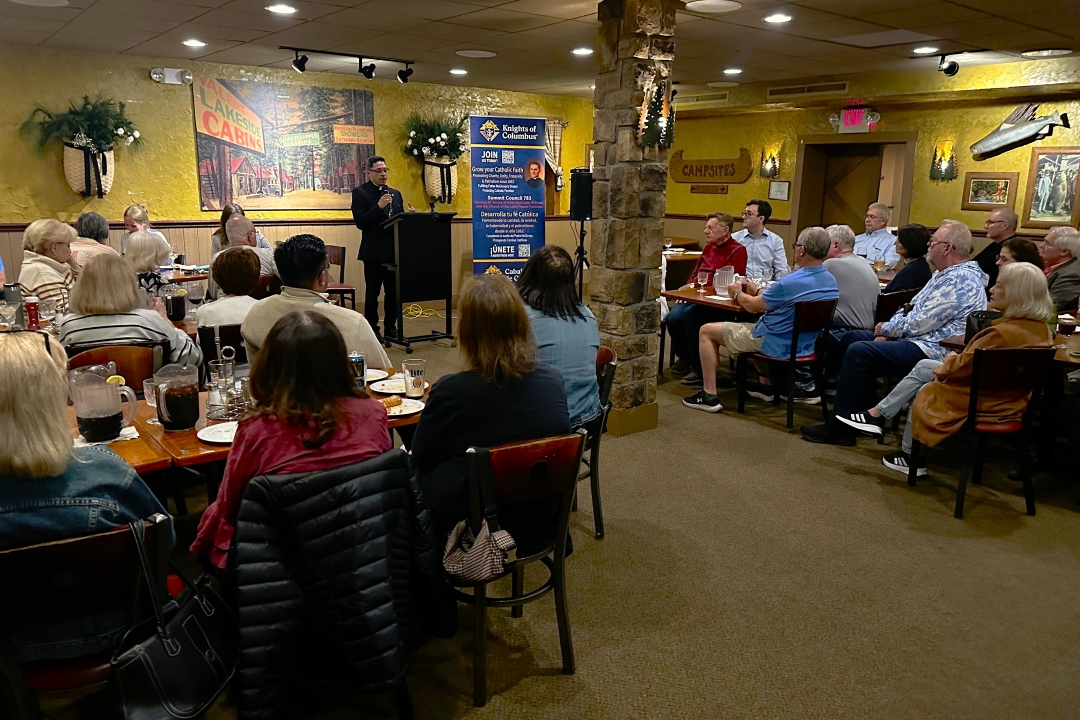
Bishop Chau looks at ‘Immigration Through the Eyes of Faith’
“Jesus does not say, ‘I was a stranger and you asked whether I deserved compassion,’” said Auxiliary Bishop Pedro Bismarck Chau of the Archdiocese of Newark. “He identifies himself personally with the vulnerable person: the hungry, the thirsty, the stranger, the sick, and the imprisoned.”
More than 50 people gathered at Vintage Tavern in Stirling, NJ, to hear Bishop Chau’s Oct. 14 presentation, “Welcoming the Stranger: Immigration Through the Eyes of Faith.” It was part of the Theology on Tap series, sponsored by Knights of Columbus Summit Council 783.
The crowd listened intently as Bishop Chau presented a detailed and nuanced look at immigration policy through a Catholic lens. The bishop emphasized that the Church’s position on immigration “is neither ‘borders without compassion’ or ‘compassion without borders.’” Rather, it pursues “justice, mercy, human dignity, security, and the common good together.”
Bishop Chau, who was born in Nicaragua, came to the U.S. as a teenager to seek asylum during an especially violent period in the history of his native land. He began his talk by citing Christ’s words about the last judgment:
I was a stranger and you welcomed me.”
– Matthew 25:35
Bishop Chau said that these words, while “not an immigration statute,” provided the “moral lens through which Christians must approach the issue.”
Rights, responsibilities, and principles
During his talk, the bishop also cited Church teaching on the issue of immigration, in particular the Catechism of the Catholic Church no. 2241, last year’s Special Pastoral Message on Immigration from the USCCB, and a joint pastoral letter from the bishops of the U.S. and Mexico, “Strangers No Longer: Together on the Journey of Hope.”
Church teaching strikes a balance on the issue of immigration, Bishop Chau said; emphasizing that “Catholic teaching recognizes rights and responsibilities on both sides.”
The catechism “teaches that prosperous nations have an obligation, ‘to the extent that they are able,’ to welcome foreigners seeking security and a livelihood they cannot find at home.” However, that same teaching also states that immigrants also have responsibilities, including the respecting the heritage of the host country, obeying its laws, and carrying out civic responsibilities.
Drawing upon the joint letter from Mexican and U.S. bishops, Bishop Chau laid out five basic principles at the heart of Catholic teaching on the issue.
-
- People have a right to find opportunities in their homeland.
- People have a right to migrate when necessary to sustain themselves and their families.
- Sovereign nations have a right to control their borders.
- Refugees and asylum seekers deserve protection.
- The dignity and human rights of undocumented migrants must be respected.
Bishop Chau said that these principles show that the Church is neither against borders nor indifferent to immigrants.
Controlling borders in a humane and morally acceptable way
Bishop Chau also explained that as the Catholic Church recognizes a nation’s right to uphold its borders, the USCCB has stated that the Church does not advocate for open borders. In fact, from a Catholic perspective, borders are important because they protect the innocent from dangerous and illegal activities, maintain order and the rule of law, protect migrants from violence and exploitation, contribute to the common good, and show respect to those who follow the law or who legitimately require asylum.
The Church has stated that this right “must be balanced with charity, human dignity, and respect for human life,” the bishop said.
He explained that not every enforcement action is morally acceptable, however. The USCCB’s position on enforcement is that it “should be targeted, proportional, and humane,” and should be focused on “genuine dangers such as gang activity, drugs, and human trafficking,” while respecting “human dignity, family relationships, and due process.”
The bishop stressed that there is no conflict between human dignity and national security.
In their “Special Letter” released last year, bishops “expressed concerns about fear, profiling, detention conditions, family separation, arbitrary loss of legal status, and threats to access to churches, schools, hospitals and pastoral care,” he said. At the same time, U.S. bishops reaffirmed the “responsibility of nations to regulate borders.”
A framework to help Catholics look at immigration policy
Rather than viewing immigration policies exclusively through the lens of one’s political affiliation, Catholics are invited to judge proposals through a framework informed by their faith, the bishop said.
He suggested a series of 10 questions that Christians can ask when confronted by a policy or concrete proposal:
-
- Does it respect the dignity of the human person?
- Does it protect the common good?
- Does it recognize the legitimate authority of government and the rule of law?
- Does it protect the nation from genuine threats?
- Does it protect refugees, asylum seekers, children, trafficking victims, and other vulnerable persons?
- Is enforcement proportional, humane, and accompanied by due process?
- Does it protect family unity whenever reasonably possible?
- Does it provide realistic legal avenues for migration?
- Does it encourage immigrants to obey the law and integrate into the receiving society?
- Does it address the conditions that force people to migrate in the first place?
By asking these questions, the conversation about immigration can be moved “from ideology to Catholic moral discernment,” Bishop Chau said.
Welcoming the stranger
Bishop Chau concluded by pointing out the reasonableness of the Church’s position on the immigration issue:
“The Catholic Church recognizes something that our political debate often finds difficult to hold together. A nation has the right and responsibility to know who enters its territory, to protect its citizens, to combat drugs, trafficking, criminal activity, and exploitation, and to establish an orderly immigration system. But the person standing at that border never ceases to be a child of God. His legal status may affect what the government may legitimately do, but it never determines his human dignity.
This is why the Church does not ask us to choose between compassion and security. It asks us to pursue both. It does not ask us to choose between welcoming the stranger and respecting the rule of law. It asks us to create laws worthy of the human person and then enforce them with justice, prudence, and mercy.”
“When Jesus says, ‘I was a stranger and you welcomed me,’ he changes the question,” Bishop Chau concluded. Though the government has the responsibility to ask legal questions, the Christian cannot simply stop and ask if the stranger has permission to be in their land, but must also ask, “How must I treat you because you bear the image of God?”
“Catholic teaching insists that society must be capable of asking both questions at the same time,” he said.
A Q&A followed the bishop’s presentation. Kathy O’Leary, a representative of Pax Christi NJ who attended the talk, also spoke about her ministry at the Delaney Hall detention facility and how people can help in that work.
Visit the website of Knights of Columbus Summit Council 783 to learn about future Theology on Tap events.
To view more images from Bishop Chau’s Theology on Tap presentation, CLICK HERE.
Featured image: Bishop Pedro Bismarck Chau participated in a Theology on Tap evening on Oct. 14, speaking about a Catholic understanding of immigration. (Photo courtesy of Dan Grossano)