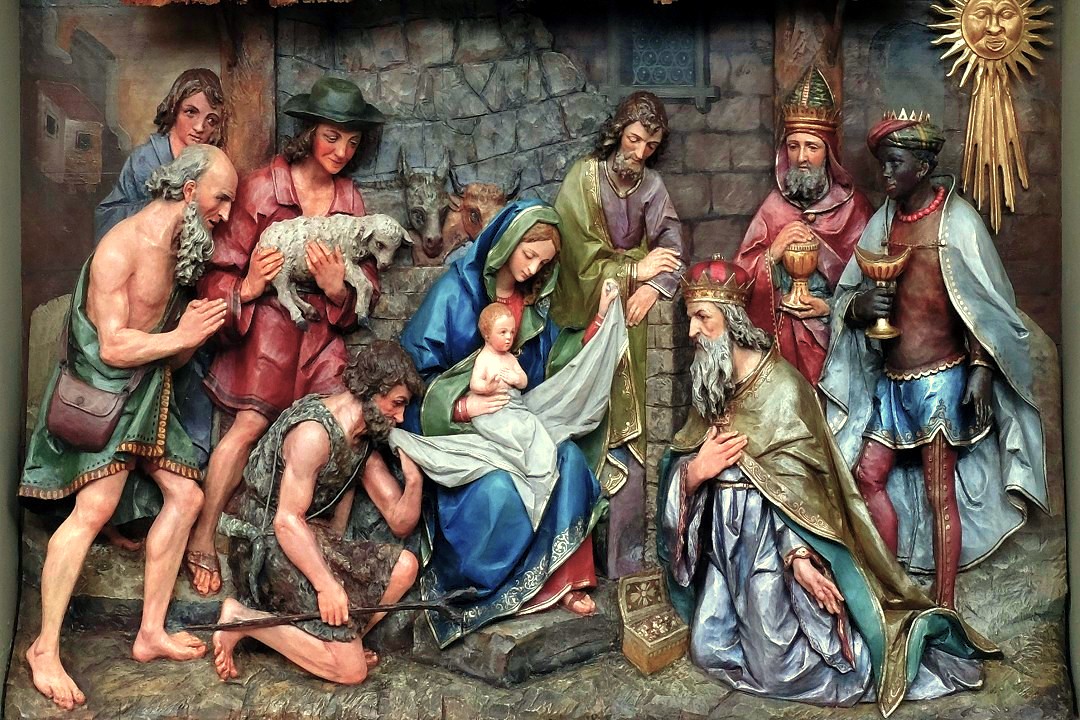
Pope Saint Leo the Great really loved the Nativity
I get the sense that Pope Saint Leo the Great really loved Christmas.
In the 5th century, Christmas was a celebration, to be sure, but as a holiday, it paled in comparison to celebrating the Feast of the Epiphany on January 6. The first nativity set hadn’t been invented yet. There was no Black Friday shopping. No Christmas tree. No Christmas caroling. Advent was already a deeply cherished season in the Christian calendar, and Epiphany commemorated the fullest revelation of the divinity of Christ, but Christmas was a minor holiday.
Pope Leo I, though, knew that if Epiphany is the culmination of a miracle, we shouldn’t overlook the beginning. Even though the nativity is shrouded in midnight darkness, it has a magic all its own. If Epiphany arrives like a blaze of light to illuminate the glory of God, the spark is that little Child in the crib.
Jesus really is one of us
In the 5th century, people still argued over the meaning of the Incarnation. Was Jesus really one of us? What does it mean to believe the Nicene Creed and the fact that he “assumed” human nature? The Church answers that, yes, Jesus is really one of us and, yes, he assumes the fullness of human nature while remaining fully divine.
Pope Leo understood that the key to understanding the theological dogmas about Christ is intuitively found in the Nativity. This is why he loved Christmas so much. In a beautiful and irreplaceable way, the feast returns us to the heart of our faith.
Leo the Great loved it so much that he preached a series of famous homilies for the season. In one of them, he preaches that spiritual insight arrives in our meditation on the arrival of the Christ Child.
His point is simple. Christ is a real person. He isn’t an idea in a book or an academic definition. In order to draw closer to him, we can begin by looking at the nativity. Adoring the Christ Child, who seems small and helpless, is a way of adoring the limitless God in Heaven who surpasses comprehension. Lingering before the Crib, our prayers reach much further than we suppose.
“Borne in upon our senses,” preaches Pope Leo, is the “brightness of this wondrous mystery.”
Looking at the Nativity with the eyes of a child
One of the most touching scenes every year for me is during Christmas when I see the small children in our church at the nativity. I’ve witnessed toddlers give Christ their clumsy kisses, the camels receive their rough caresses, and the light from the star reflecting in their eyes. Those small and innocent attentions, often accompanied by mumbled prayers and simple exclamations of astonishment that Jesus is right in front of them to be seen and touched, those seemingly insignificant interactions are prayers that ring glory throughout the heavenly vault.
The nativity, when approached as a child would, is a scene of imaginative wonder. It isn’t a trinket or unimportant decoration. It contains mysteries of great theological depth.
What’s most fascinating about those mysteries isn’t the mere fact they exist, but the way in which they exist. The nativity isn’t a lesson. Rather, the nativity is a participatory experience.
All art is participatory. As Wendell Berry observes in his essay Style and Grace, “Works of art participate in our lives; we are not just distant observers of their lives.” Through undertaking to manifest beauty, the artist remains in conversation with us. So does the subject of the art. So do all the other people who have participated in that same work of art. Beauty is unifying. It has vitality and life.
If we can say this about art in general, how much more does this hold true for the nativity, a work of art that brings to our sensible devotion the Living God?
An ongoing event
Christ is still redeeming. Our Lady is still birthing. Grace is still being poured out as a result of an event that took place long ago. Pope Leo is insistent that the nativity is not limited to the past. It’s ongoing. The Christmas festival, he teaches, “renews for us the holy childhood of Jesus born of the Virgin Mary: and in adoring the birth of our Saviour, we find we are celebrating the commencement of our own life.” The birth of Christ, when we approach it with devotion, becomes our own birth.
In the 5th century, the custom of putting nativity sets out at Christmas didn’t exist yet, but Leo was interested not so much in a specific nativity or the work of one artist as much as he was interested in the way we imaginatively participate in the scene and make it ours. The Church has always loved a wide variety of art for this very reason, because it develops and encourages the imagination.
Perhaps your family has a beloved nativity under the tree, or you love the nativity in your parish. Maybe your family enjoys reading the Christmas story in Luke’s Gospel and thinking about it. I once played Joseph in a living nativity (which was quite the experience).
The form in which the beauty arrives to us is varied, but what really matters is that it’s for us. Pope Leo wasn’t thinking about one specific work that he hoped we all could see.
Participating in Christ’s life
That’s the point. We are the ones who, through our imaginations and our particular nativities and traditions, participate in the original nativity. In such a way, we find ourselves at the side of the newborn Christ.
For Pope Leo, this participation in the life of Christ was the whole reason Christmas matters. He teaches that Jesus is fully God but also fully human. He really did live and die, sharing our existence here on earth. This means that we can get close to him, love him, celebrate him, picture his face, make art and images and nativity sets with him in them.
The nativity is such a humble object. It doesn’t seem much, but even the most battered, hand-me-down nativity opens us up to spiritual participation in the mystery of Christmas. “You will reach the topmost height,” says Pope Leo. The Epiphany, rightly understood, begins on Christmas, and that Child in the Manger is already shining with everlasting glory.
This article was written by Father Michael Rennier for Aleteia.