Panelists emphasize faith and vigilance in ‘Restoring Hope’ for victims
How can we face some of the most painful problems in our Church and society while remaining hopeful? What warning signs should we look out for in our homes, parishes, schools, and communities? In these deeply divided times, is it possible to combat issues like child abuse, human trafficking, and the exploitation of migrants in ways that truly promote healing and peace?
These were some of the questions addressed by three panelists during a discussion hosted by Our Lady of Grace and St. Joseph Parish in Hoboken on May 19. Titled “Restoring Hope: Overcoming Exploitation at the Intersections of Faith, Culture and Vulnerability,” the event was organized by the Archdiocese of Newark’s Department for the Protection of the Faithful.
The one-hour discussion opened with a moment of prayer led by Auxiliary Bishop Pedro Bismarck Chau, and was then moderated by Father Alex Santora, pastor of Our Lady of Grace. The three panelists, experts in their fields, spoke about identifying and preventing abuse and exploitation, promoting healing among victims, and bringing hope to communities that are often overlooked or ignored.
Facing painful realities
Mark Joseph Williams, an author and forensic psychological clinician, led off the discussion by speaking about his experiences as a survivor of clerical abuse. He echoed recent calls by Pope Leo and Pope Francis to truthfully face the issue of sexual abuse in the Catholic Church, and to build bridges of peace and understanding through the synodal path that Pope Francis began, and his successor has promised to continue.
While acknowledging that that many victims may never enter a church again, Williams, who serves on the United States Conference of Catholic Bishop’s North American Safeguarding Committee, said that “the Church that hurt me is the same Church that healed me.”
“To be abused is wrong and my suffering was wrong, but I believe Jesus carries my cross,” Williams said.
He expressed his gratitude to the Archdiocese of Newark, the Department for the Protection of the Faithful, and particularly to Cardinal Joseph W. Tobin, C.Ss.R., Archbishop of Newark, for his friendship and for encouraging him to make his voice heard. He said that relationship had played an important role in his journey of healing and in finding the courage to speak up.
How silence can become a rule
Father Alex Gaitan, Coordinator of Immigration Ministry for the Archdiocese of Newark, who said that he was “very humbled” by the invitation to speak, began by pointing out that abuse and exploitation can exist close to home, in one’s own family, and often find their root in stereotypes or in the casual acceptance of domestic violence.
“Here in the Americas, 73 million children are victims of violence at home or in school,” Father Gaitan said. Children are taught to remain silent out of shame, threat of further punishment, or cultural taboos. “There are no tools for children to defend themselves and so silence becomes a kind of rule,” he said.
He added that many cultures perpetuate an atmosphere of violence against women and children and encourage silence “to preserve the harmony of the community and the family,” and that these attitudes can also exist in the church.
The need to work together
That cultural norms are often used to defend exploitive behavior was reiterated by Stephen De Luca, an expert in immigration law who worked in the field of human trafficking for more than 20 years, including with the NJ Coalition Against Human Trafficking.
De Luca added that although many people regard human trafficking as something that only happens in third world countries, “the US has been a source destination and transit country for many years.” While traffickers often exploit refugees and immigrants, they have also found that grooming and exploiting American citizens is “a lot cheaper than having to groom them from abroad.”
The form of exploitation can be sexual or economic, he said.
According to De Luca, trafficking can happen anywhere, including “within walking distance of the White House,” in cities like New York or Newark, or in our own neighborhoods.
He warned that traffickers know how to identify the vulnerable and exploit them. “There are criminal enterprises that are involved in trafficking. In fact, it’s the second largest criminal enterprise in the world,” he said. “That is what we are up against.”
“There is no one thing that is going to stop this; we all have to work together,” De Luca stated.
The importance of listening and acceptance
During the Q&A session, all three panelists emphasized the importance of community, along with the need for listening, awareness, and vigilance when seeking to prevent abuse and help victims.
Asked how he found the courage to speak up as a survivor of clerical abuse, Williams said, “I’ve just been gifted with having some people walk with me,” including Cardinal Tobin. He recalled their first meeting and how the cardinal immediately listened to him and accepted him for who he was. It was one of many signs for him that God was at work in his life. “It hasn’t been easy for me, but I was helped by therapy and blessed to discover the sacramental grace of the Eucharist,” Williams shared.
He also stressed the importance of speaking up with honesty and transparency when experiencing or witnessing abuse or exploitation.
“I would say that it’s really important first for any kind of recovery to begin for people to just listen and believe,” De Luca said. He added that he has seen how those who are victimized by abusers or traffickers can find a voice “to the point where they are leading meetings professionally in their own organizations. That’s a positive message.”
A wounded people in need of redemption
Asked about how to face these issues in a society that is deeply divided, Father Gaitan drew on his own experience ministering to immigrants being held at Delaney Hall immigrant detention facility. He pointed out that he must work daily with those running the facility as well as those who publicly oppose it.
“As Catholics, we need to learn how to walk that line, while always trying to be on the side of the one who suffers,” he said.
Father Gaitan said that it was also important to have an awareness that “all of us in the Church are wounded people,” and that the key to healing is faith. He pointed to the Gospel story of the woman suffering from a hemorrhage who is healed by Jesus (Mark 5: 25-34).
“She was already stigmatized by her brokenness, discriminated against, and an outcast from her community,” Father Gaitan said. “But in the end, her faith – which I think is really the faith of the survivor – is what helps her to flourish and go beyond.”
“In the midst of all the woundedness that all of us have, there is a sense of redemption,” he said.
For more information about how to prevent and report abuse or exploitation, visit the Archdiocese of Newark’s Department for the Protection of the Faithful.
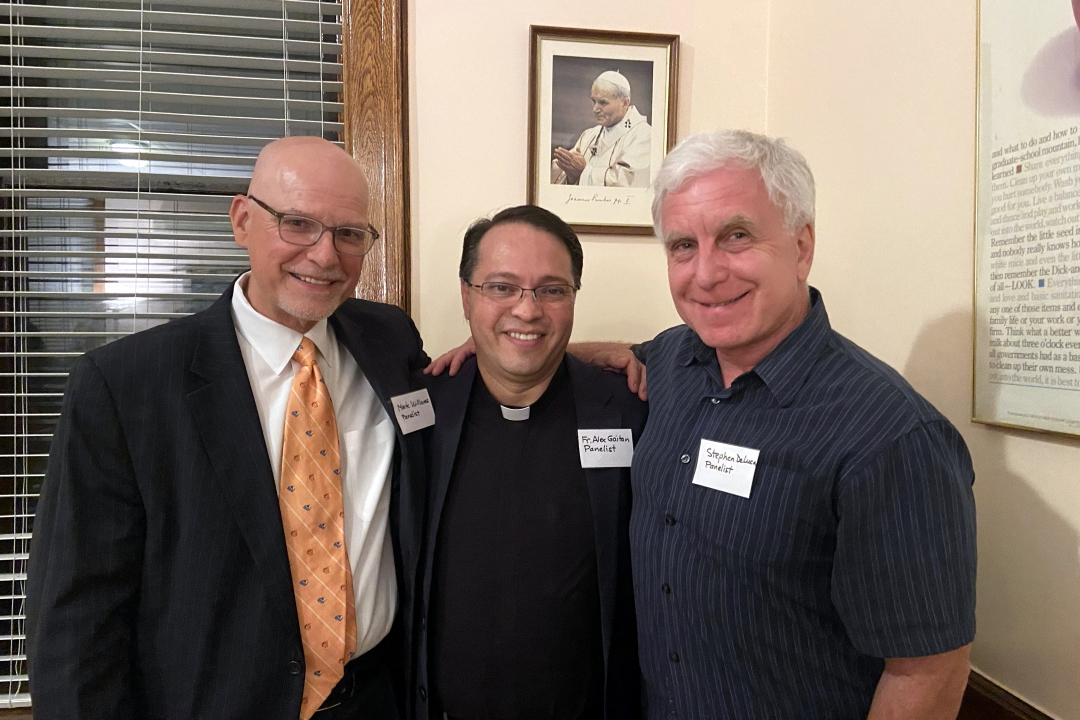
Featured image: (Left to right: Mark Joseph Williams, Father Alex Gaitan, and Stephen De Luca spoke during the May 19 event, “Restoring Hope,” sponsored by the Archdiocese of Newark’s Department for the Protection of the Faithful. Photo by John Touhey / Archdiocese of Newark)