Lost homily of Fulton Sheen resurfaces in Newark
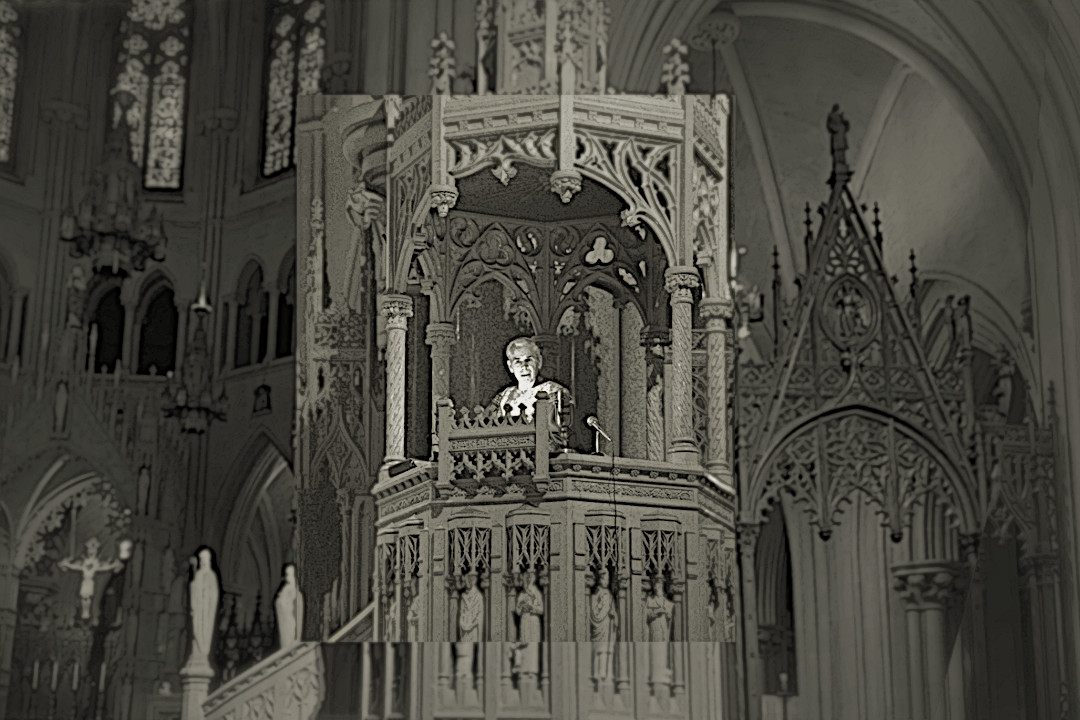
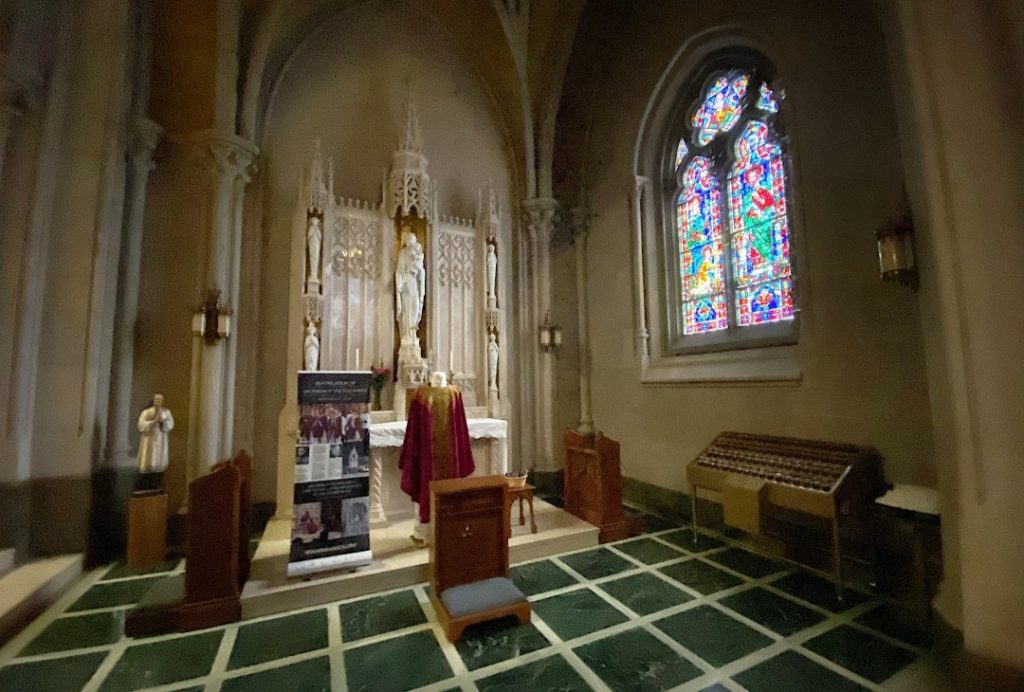
As the Catholic Church prepares to beatify Archbishop Fulton Sheen, Cathedral Basilica of the Sacred Heart in Newark, NJ, is currently displaying a second-class relic of the beloved communicator — a chasuble he wore when celebrating Mass in the cathedral on March 6, 1977.
At the time, Sheen was living in retirement in New York City. He came across the Hudson River to Newark at the invitation of its shepherd, Archbishop Peter Leo Gerety.
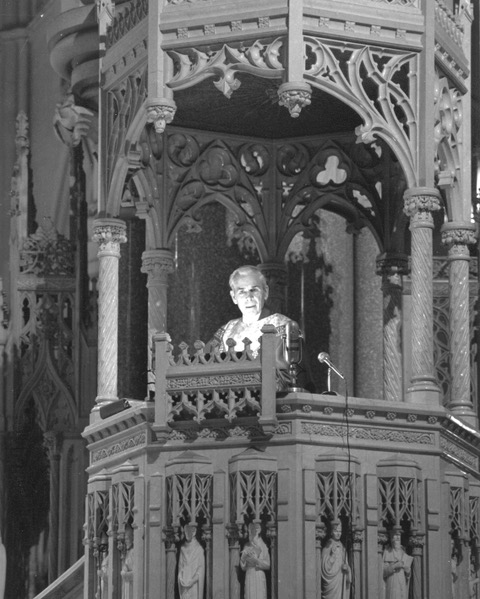
Archbishop Sheen celebrated Mass for the second Sunday of Lent (sitting in the cathedra at the invitation of Archbishop Gerety) and delivered the homily.
A special audio recording of the Mass was made that day and, almost fifty years later, the man who recorded it recently shared a digital copy with Fr. Matthew Gonzalez, the current rector of Newark’s cathedral.
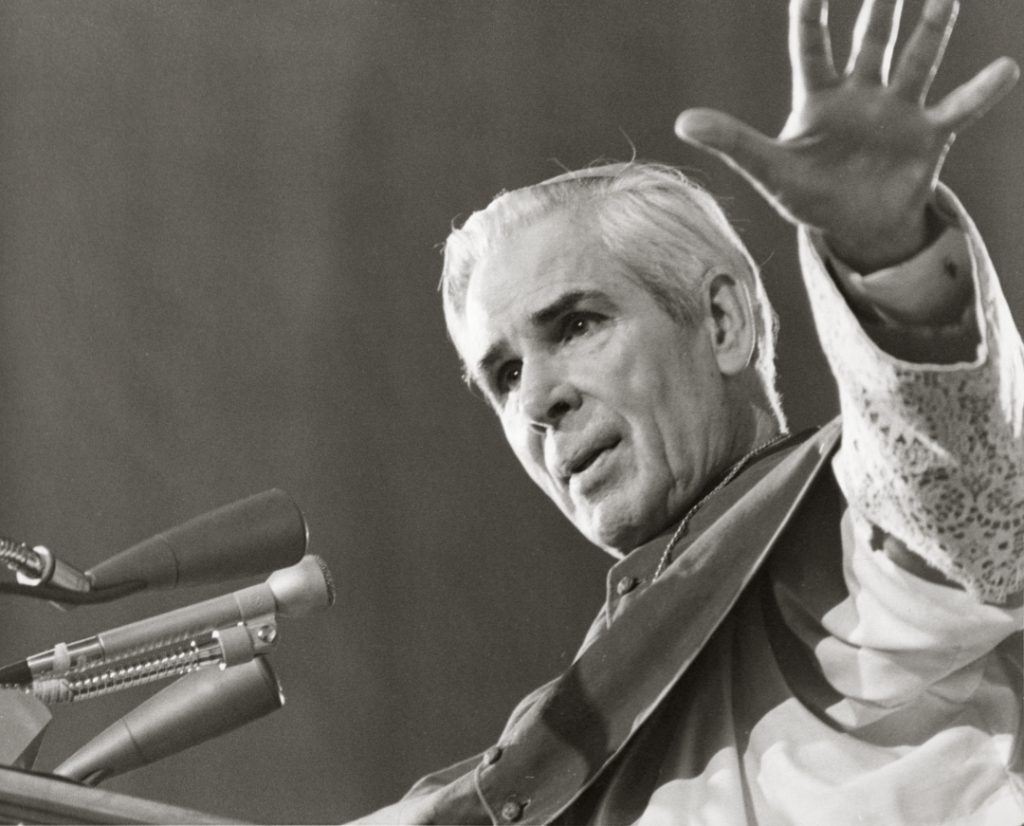
Archbishop Sheen’s voice speaks again
“I had no idea that Archbishop Sheen had visited the cathedral before I received the recording,” Father Gonzalez told Jersey Catholic. “I felt like I was listening in on something sacred, almost as though a moment from our past had suddenly come alive again. But I also had this strong sense that it was something meant to be rediscovered and shared. After all these years, Sheen’s voice was speaking again from the cathedral.”
The recording led Father Gonzalez to the archdiocesan archives, which had preserved photos and documentation of the event. He was also able to locate the chasuble Archbishop Sheen wore at the Mass. “The recording opened the door to rediscovering a special moment in the Cathedral’s history,” Father Gonzalez said.
Among the most interesting of those rediscoveries is the homily Archbishop Sheen delivered that day. Unheard by the public for 47 years, the lost homily “speaks to a Church living through changing times, something we can certainly resonate with today,” Father Gonzalez said.
“How good it is for us to be here”
The day’s Gospel reading was from Matthew, telling the story of the Transfiguration of Jesus atop a mountain, traditionally associated with Mt. Tabor.
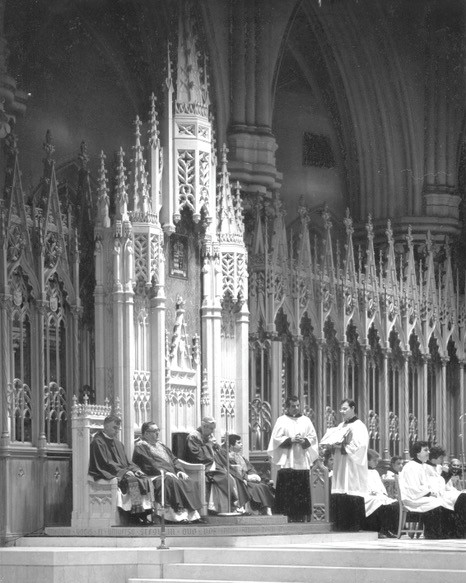
But before Fulton Sheen delivered his homily, Archbishop Gerety ascended the pulpit to welcome him, quoting St. Peter’s words to Jesus during the Transfiguration: “Master, how good it is for us to be here.”
“I come here to express to you the joy and happiness that we all have in our hearts as we see you here,” Archbishop Gerety said, adding that the people of the archdiocese were “greatly honored” by the Sheen’s presence, which he personally considered to be “a great privilege.”
There was loud and sustained applause as Archbishop Sheen rose to preach.
“I accept your applause at the beginning as a manifestation of faith,” Archbishop Sheen began – joking that if there was any applause during the homily it would be based on “hope,” and at the end, on “charity.”
He also assured the people of Newark that he was not filling Archbishop Gerety’s place, but “just rattling around in it.”
A division in the Church
Then, noting his extensive travels around the country, he observed that “the Church is to some extent split.”
“Great changes have taken place,” Archbishop Sheen noted. “For example, 30 or 40 years ago, almost the sole emphasis of the church was on individual sanctification. Today, it is on social development.”
The two different sides “are not coming together,” Archbishop Sheen said. “On the one hand, there is the vertical church that says the business of the church is just to have a vertical relationship to God. On the other hand, there is the horizontal church which claims that our sole business is in this world.”
“Why ever go down from this mountain?”
The answer to the division, the archbishop continued, can be found in the Transfiguration of Christ and on the events immediately afterwards:
“When (Jesus) ascends onto the mountaintop, He is transfigured. That is to say, His body began to shine as the sun, and His garments became white as snow. I wonder if this really was not the ‘natural’ state of our Lord. (…) I wonder if our blessed Lord during His public life did not constantly have to restrain the manifestation of His divinity.”
The Old Testament prophets Moses and Elijah also appeared with Jesus. “They talked about our Lord’s death, death under the analogy of the Exodus,” Archbishop Sheen explained. “He would take us from the Egypt of sin, and He would pass Himself through the wilderness of Calvary and then come to the glory of the Resurrection.”
The archbishop continued:
When Peter saw all of this glory, he said, ‘Oh, it’s good for us to be here.’ In other words, ‘Lord, let’s stay here. Why ever go down from this mount?’”
In that moment, the archbishop said, Peter “became the symbol of the Church on the mountain, the spiritual Church, the Church of contemplation, the Church of ecstasy…”
“Our blessed Lord did not answer Peter, but he took Peter down from the mountain into the valley,” the archbishop said. “While Peter was saying let’s just lead a spiritual life, our Lord is saying no there’s disease, there’s need, there’s poverty, there’s a weakened humanity down below.”
Walking with Peter, James, and John, the Lord then encountered “a father who’s in grave need and a son who is in graver need.”
The “mountain” Church and the “valley” Church
The son was possessed by a demon, and the father had originally brought him to the nine apostles who had been left behind. These nine represented “the valley Church,” the archbishop said; in other words, the concern for “social development, of political amelioration, of human rights and dignity.”
“And the father—representing humanity—said to the Lord, I’ve asked your apostles to drive the devil out and they cannot,” Archbishop Sheen continued. “Our Lord said, ‘Oh, you incredulous and faithless generation, how long must I suffer you?’ And our Lord drove the devil out of the young man.”
Archbishop Sheen explained that in the Gospel reading “we have two parts of the Church that failed. The Church that wanted to stay on the mountain, and the Church that remained in the valley without prayer and fasting and without the inspiration of Christ. These (are) two extremes that we find in the Church—the so-called traditionalists and the so-called progressives.”
Separately, both are imperfect, Archbishop Sheen explained. “If there is no mountain in our lives, there will never be a vision. If there is only the valley of work without the vision, there will only be drudgery,” he said.
The call to spirit and the call to action
Nearing the conclusion of his homily, the archbishop pointed to Mother Teresa of Calcutta as one who “combines the mountain and the valley, the call to the spirit and the call to action.”
Caring for the dying, the sick, and the emaciated, she was strengthened by her time with Jesus in the Eucharist, he said, quoting Mother Teresa’s own words: “I receive communion every morning and make a Holy Hour, and I find that the people that I touch during the day are a prolongation of the body of Christ.”
“She has become a lesson to the modern world,” Archbishop Sheen said. “She combines the mountain and the valley, the call to the spirit and the call to action.”
Still alive at the time of Archbishop Sheen’s homily, Mother Teresa died in 1997 and was canonized by Pope Francis in 2015. She would visit the Cathedral Basilica of the Sacred Heart in June 1995 for the profession of six Missionaries of Charity. Saint Pope John Paul II also visited the cathedral in October of that year.
Archbishop Sheen died just over two years after delivering his homily to the people of Newark. He will be beatified on Sept. 24.
A mission that never changes
Reflecting upon Archbishop Sheen’s homily, Father Gonzalez said that even if the language used to describe the Church and her mission may change over time, “the mission Christ entrusted to us does not.”
“Using the Transfiguration, Sheen speaks about that necessary movement between the mountaintop and the valley,” Father Gonzalez said. “We must go up the mountain, into communion with the Lord, into prayer and relationship with him. But we cannot remain there. We also must come down into the valley, going out to meet the people Christ that wants to encounter, carrying His presence and power into the world.”
“I think the Church is most herself when she lives that double movement of coming to Christ and going forth from Christ. We come to Him so that He can send us. And ultimately, that keeps us rooted in the deepest purpose of the Church: the salvation of souls,” he said.
You can listen to Archbishop Fulton Sheen’s lost homily to the people of the Archdiocese of Newark in its entirety below:
The Archbishop Sheen Display at Newark’s Cathedral Basilica of the Sacred Heart will continue through Oct 4. You can learn more HERE.
To learn more about the history of the Archdiocese of Newark, visit the archdiocesan archives.
Featured image: Archbishop Fulton Sheen celebrated Mass at the Cathedral Basilica of the Sacred Heart on March 6, 1977. (Collage photos by John Touhey / Archdiocese of Newark / Archdiocese of Newark Archives)