Jubilee event invites us to embrace persons with disabilities with open-mindedness and hope
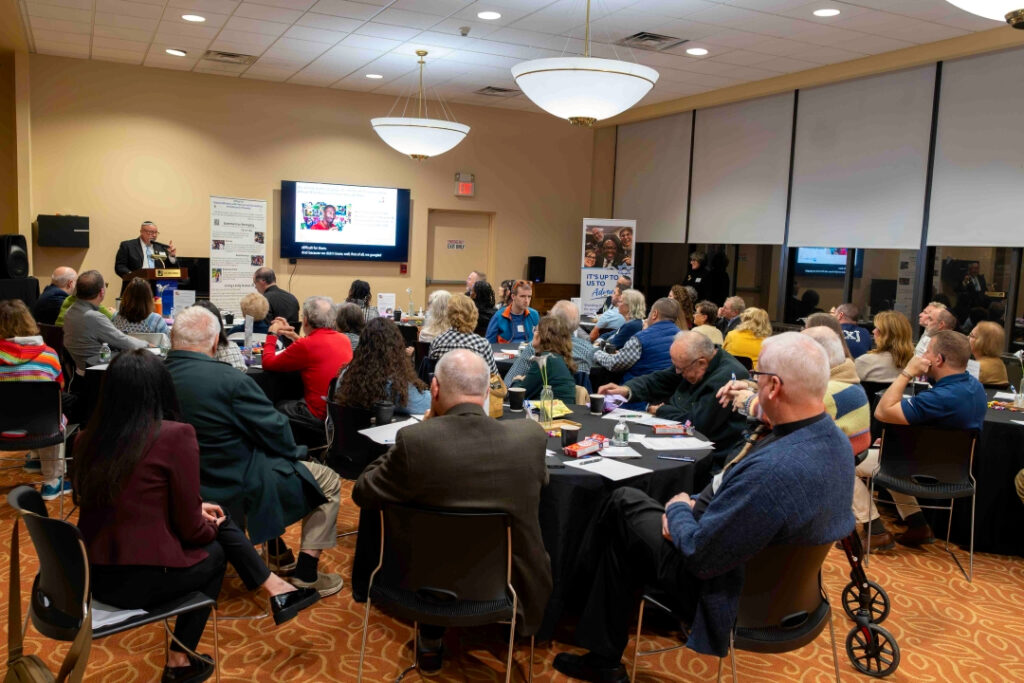
On the evening of Oct. 21, 55 members of the Catholic and Jewish communities gathered at JCC Metro West in West Orange, NJ, to explore new perspectives on neurodiversity and discover how people with intellectual disabilities can find acceptance and belonging.
The event, Disability and Belonging: An Interfaith Conversation About Building Communities of Hope, was a collaboration between the Archdiocese of Newark and the Jewish Federation of Greater Metrowest NJ, held to mark the Jubilee Year of Hope.
Stephanie Abrahams, Associate Director of Interfaith Outreach and Community Engagement for the Jewish Community Relations Council, said that the evening was about “coming together across traditions to explore shared values, challenge assumptions, and envision a better world.”
Breaking the cycle of low expectations
“Pope Francis defined hope as the expectation of good things to come without any concrete understanding or expectations of what might happen,” said Anne Masters, Archdiocesan Director of Pastoral Ministry with Persons with Disabilities, in her welcoming remarks. “Too often we know that individuals with intellectual and developmental disabilities don’t have hope because they are perceived by what they cannot do, versus what they can.” She said that the result is a legacy of “low expectations.”
Abrahams and Masters expressed their gratitude to both communities for coming together for the event, which featured a screening of the film Intelligent Lives, followed by a group discussion. The documentary profiles three young adults with intellectual disability who find success in school and the workforce. Masters explained that the film “gives us counterexamples to demonstrate what intelligence really is and can be when it is recognized, nurtured, and supported.”
Turning accompaniment into a reality
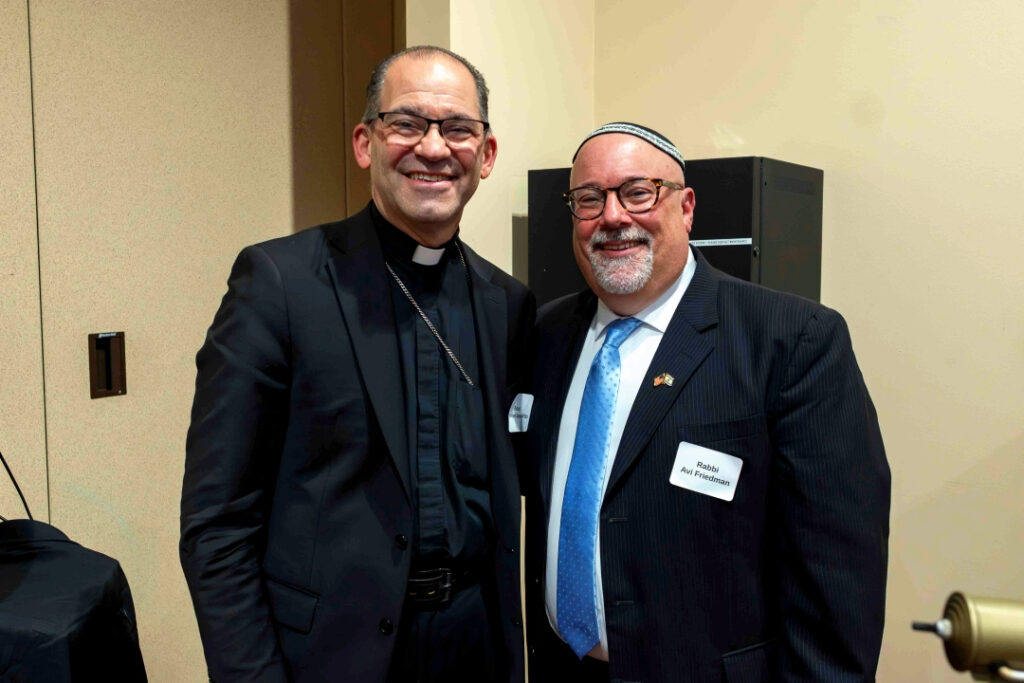
Before the screening, Auxiliary Bishop Michael A. Saporito and Rabbi Avi Friedman shared some opening remarks.
“In the Catholic world, during the Jubilee of Hope, one of the big words we hear a lot is ‘accompaniment,’” said Bishop Saporito. He said that it is an idea everyone embraces “as long as it doesn’t take too much of my extra time,” and “I don’t have to put myself out.”
He said that the film shows that accompaniment is actually “very near and very personal.”
“The success of the dreams that we’ll see in the profiles tonight are a result of people and communities coming together to make that accompaniment not just a theory, but an actual reality,” Bishop Saporito said, adding that he hoped the film would “stoke our minds and hearts.”
Making the impossible possible
Rabbi Friedman began his remarks by citing a blessing from the Talmud that translates into English as, “praised are you, Adonai, our God, power of the universe who makes creatures different.”
He spoke movingly of his experience parenting his son, Jonah, who has Down syndrome. “When he was about nine years old, we were planning a trip to Acadia National Park and heard that it was awesome to ride your bikes all around the park.”
Unfortunately, Jonah did not know how to ride a bike, Rabbi Friedman shared. “Of course, there was frustration and crying and resistance and bribery and all the things that go into parents teaching a child to ride a bike. But, sure enough, Jonah learned how to ride a bike, and he rode up and down the mountains of Acadia with the rest of the family.”
It was only later that they learned of the consensus opinion that the vast majority of people with Down syndrome could not develop the skill. Rabbi Friedman said that two years later, the University of Michigan studied the matter, using the data to establish a special program, “and now over 50% of children with Down syndrome can ride bikes.”
“Jonah taught us that when we say something is impossible, chances are it is,” the rabbi said of this son. “But if we say something is possible, who knows?”
Mismeasuring others
The screening of Intelligent Lives followed. It was received with enthusiastic applause.
The narration and commentary of actor Chris Cooper earned special praise from Rabbi Friedman during his post-screening comments delivered with Bishop Saporito. Cooper, who was also an executive producer of the film with his wife, Marianne Leone Cooper, speaks in the documentary’s opening about his son, Jesse, who had cerebral palsy. Cooper relates how a neurologist told him and his wife that Jesse would never be “intellectually normal” and how a special education director encouraged them to send their son to a hospital school. When they resisted, authorities insisted that Jesse take an I.Q. test with questions that were “antiquated” and “absurd” for a child with quadriplegia.
“When I heard [Chris Cooper] start to talk about his son’s I.Q. test, I wanted to jump through the screen and give him a hug,” Rabbi Friedman said. He explained how his family was pushed to do the same thing with his son, Jonah. During Jonah’s I.Q. test, he was asked to identify an image showing two golden arches. “I imagine most of you know what it was, but Jonah didn’t because his family keeps kosher, and he had never set foot in a McDonald’s!”
He went on to explain that although Jonah cannot do calculus, “he knows the names of more people in my congregation than anyone, including me.”
“Jonah has a social intelligence that is off the charts,” Rabbi Friedman said. “That is something that ought to be valued even if it doesn’t come across in a standard test.” He added that we often judge people with disabilities “with a scale weighted to their detriment” and by doing so “we are denying ourselves the blessings that these beautiful, intelligent lives provide in this world.”
Lives worthy of our time
Bishop Saporito also felt a personal connection to the film, sharing that he has recently become the great-uncle of a child born with intellectual disabilities. “Suddenly, intellectual disability is not just a subject, but a person,” he said.
He said that learning personal stories like those shared in Intelligent Lives shows us that people with intellectual disability have the same aspirations as everyone else and that “every life truly matters” and can make a difference.
“Taking the time and making the effort for people to discover how truly marvelous they are is worth our time,” Bishop Saporito concluded.
During the table conversations that followed, participants discussed topics such as becoming more open to neurodiversity, building relationships and support networks for those with intellectual disability, and ways to welcome families with disabilities into faith communities. One participant, Corey, shared his daily challenges and experiences as a person with special needs. He said that the film had inspired him to advocate for and assist others like himself.
You can view more photos of the Disability and Belonging Jubilee event HERE.
Learn more about the Office for Pastoral Ministry with Persons with Disabilities.
Featured image: Participants discuss the film Intelligent Lives, during the Jubilee event Disability and Belonging: An Interfaith Conversation About Building Communities of Hope on Oct. 21. (Photos by Julio Eduardo Herrera / Archdiocese of Newark)