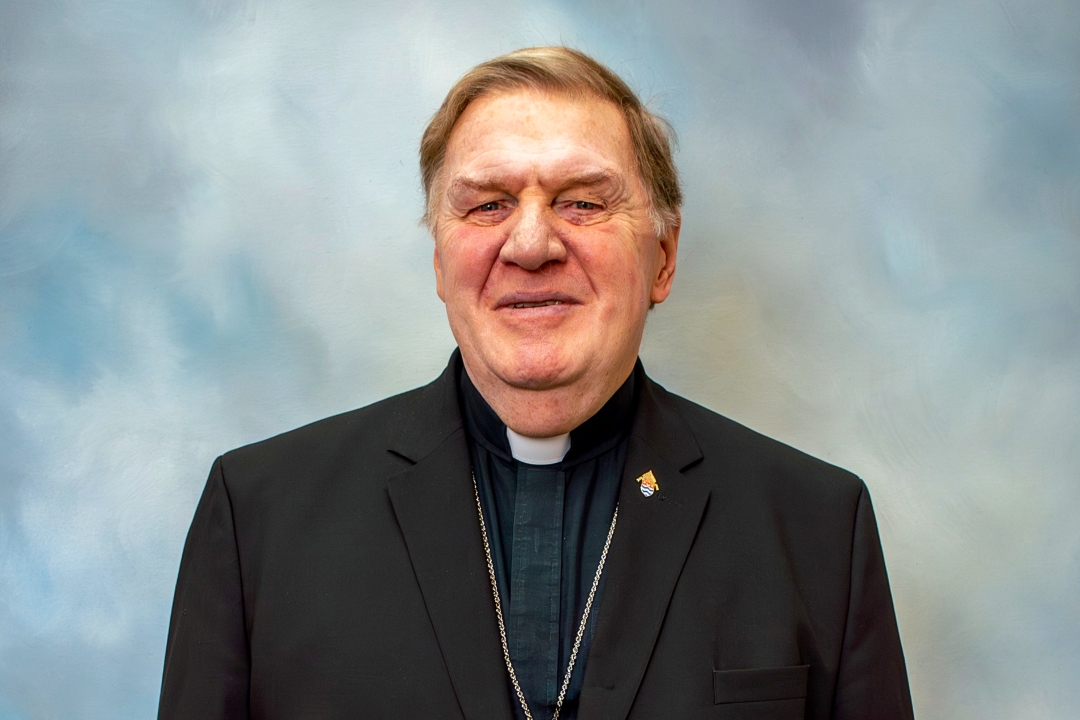
Cardinal Tobin reflects on Saint Patrick’s Day
On Saint Patrick’s Day, Cardinal Joseph W. Tobin, C.Ss.R., Archbishop of Newark, reflected on the life of Ireland’s patron saint in a video message that was posted by the United States Conference of Catholic Bishops (USCCB) on its Instagram feed.
In his reflection, Cardinal Tobin reminds viewers that “before he was a saint, St. Patrick was an immigrant, a young man taken from his home, carried across the sea, and forced to begin slave labor in a foreign land.”
While Saint Patrick’s Day is associated with wonderful traditions, the cardinal says that St. Patrick “didn’t forget the circumstances of the country that once enslaved him.”
Cardinal Tobin speaks about his grandparents and great-grandparents, who immigrated from Ireland to the United States. “Like so many who came to these shores, they knew the ache of leaving their homes,” he says. “Wakes were celebrated for them before they left, because their families had little hope of seeing them again.”
The cardinal invites those celebrating St. Patrick’s Day to “recognize the new Irish among us, who left their homes because of persecution, because of poverty, and came to this new land with hope.”
“Let us welcome them as fellow sons and daughters,” he says.
Celebrating and learning
Cardinal Tobin also spoke with Jersey Catholic about his memories of celebrating Saint Patrick’s Day with his family.
“For the Tobin clan in southwest Detroit, St. Patrick’s Day was the beginning of spring,” he said. “It could be sleeting or raining, but when my father left for work, he was always wearing a white boutonniere tinged with green on his suit coat.”
Along with his brothers and sisters, “we would wear something green on our parochial school uniforms,” and in the evening sit down for a meal of corned beef and cabbage. “A lot of Irish in Ireland would not have that on St. Patrick’s Day, but that was the tradition of Irish in southwest Detroit,” he said.
The cardinal added that it was important to learn from the lives of the saints and what motivated their lives of sacrifice and service. “Saint Augustine said that what makes a martyr isn’t the pain, it’s the cause,” he said.
“Saints are our older brothers and sisters,” and “people that lived for God and found holiness in the circumstances where they were,” he continued.
Renowned saints and nameless saints
A saint like Mother Cabrini comes to mind as an example, Cardinal Tobin said. “Several years ago, in a New York survey, she was judged to be the woman who had the greatest impact on New York City, simply because of her care for migrants.”
“I also think of the nameless saints who came out of those migrant communities, people who suffered but remained faithful to their own dignity and to their faith,” he said.
“An American writer of the 19th century, Ralph Waldo Emerson, once said that he never met a gray-haired Irishman, simply because they died so quickly,” Cardinal Tobin added. “Many of them had come shortly after the Irish Famine and were already weakened. They were poor. The first slums in New York were created for the Irish. But their perseverance, even though we don’t know their names, allowed them to pass on the faith to generations like my own family.”
“So, it isn’t simply the suffering, but it’s the cause that makes a witness, to use the English translation of the Greek word for martyr,” Cardinal Tobin concluded.