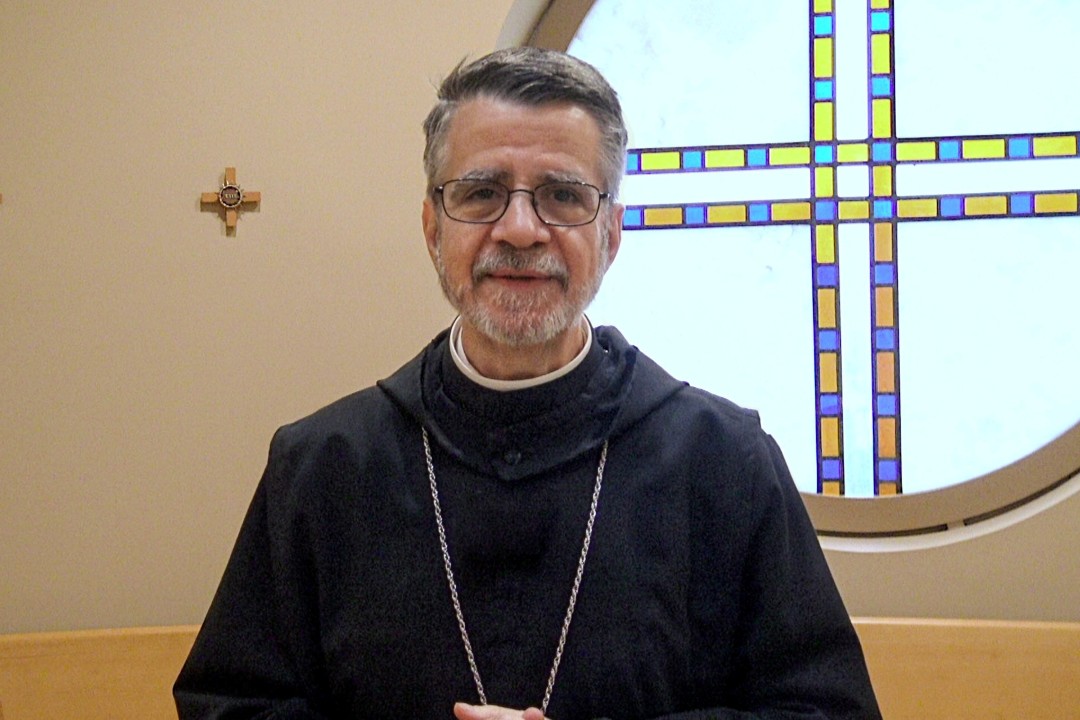
Bishop Elias on dialogue between Catholics and Muslims
This year, Ash Wednesday, which marks the beginning of Lent for Catholics, coincided with the first day of Ramadan, the holy month set aside by Muslims for fasting, prayer, self-discipline, charity, and spiritual renewal. According to Auxiliary Bishop Elias R. Lorenzo, O.S.B., this “rare synchronicity” can have a positive impact on how Catholics live the Lenten season.
In addition to serving the faithful of Union County for the Archdiocese of Newark, Bishop Elias serves as co-chair of the United States Conference of Catholic Bishops’ (USCCB) National Catholic-Muslim Dialogue (NCMD). The initiative seeks to build greater understanding, esteem, friendship, and solidarity between the peoples of both faith traditions.
Jersey Catholic recently spoke with Bishop Elias about the NCMD and how its work can inform the ways Catholics relate to their Muslim neighbors and experience Lent.
How did you first become involved in interreligious dialogue efforts?
Bishop Elias: At a plenary session of the USCCB, Bishop Joseph Bambera from the Diocese of Scranton, who serves as chairman of the USCCB’s Ecumenical and Interreligious Affairs Committee, invited me to serve as co-chairman of the National Catholic-Muslim Dialogue (NCMD), which falls under his committee. With Cardinal Tobin’s permission, I accepted the invitation. The dialogue structure includes a Catholic Bishop and a Muslim Imam, who serve as co-chairmen, along with six Muslim theologians and six Catholic theologians, working together on various projects. My co-chairman is Imam Kareem Irfan, Esq. from Chicago.

The first project that I was engaged in was on the environment. The NCMD hosted a symposium at The Catholic University of America on September 9, 2025, in honor of the tenth anniversary of Pope Francis’s encyclical Laudato si. The Muslim community has a parallel document on the environment, Al Mizan. I invited Bishop John Stowe, OFM Conv, from the Diocese of Lexington, to speak on Laudato si, and Imam Kareem invited Imam Saffet Catovic from Drew University to speak on Al Mizan.
It was a fruitful exchange and an engaging conversation about caring for our common home. The NCMD also recently produced a brief text on Islamophobia, from one of our Catholic members, Jordan Denari Duffner. Currently, the members of the NCMD are studying and researching new topics together, such as Social Friendship, Environmental Justice, Discerning Truth in an Age of AI, and Spiritual Communion between Catholics and Muslims, among others. The mutual respect and friendship among the members of this dialogue is truly genuine and sincere.
In its annual greeting for Ramadan, the Vatican Dicastery for Interreligious Dialogue states that: “Our world is thirsting for fraternity and true dialogue.” At a time when animosity and conflict dominate the headlines, what does true dialogue consist of?
Bishop Elias: True dialogue involves much more than just a polite exchange of words or a negotiation to reach a compromise. In our Catholic tradition, especially since the Second Vatican Council, dialogue has been articulated as a profound, transformative encounter designed to move participants from mere coexistence to an ever-closer sense of communion. There are four means that come to mind for assisting Catholics who are seeking to engage in “true dialogue.”
First, the Church has in recent years focused a lot of attention on what has been called the “Dialogue of Life,” especially with respect to interreligious encounters, not least between Muslims and Catholics. This is the most fundamental level of dialogue, per se, and it relies less on academic theology than on understanding and encouraging daily interactions of ordinary Muslims and Christians. For example, Catholics and Muslims might explore how to address shared experiences, such as how to share the joys and sorrows of our society and, if appropriate, our families. We can also seek opportunities for practical solidarity, such as collaborating on local issues like poverty or community safety.
Secondly, the Church seeks intellectual and spiritual openness between Catholics and members of other faith traditions. What this entails is straightforward: true dialogue requires a specific internal posture of humility (e.g., it is not an attempt to “win” an argument or convert the other person) even while acknowledging and honoring the truths of one’s own faith tradition. It is important to recall that we can all learn something about God/the divine from another’s experience. To do this well, a certain measure of reciprocity, i.e., with respect to a commitment to listening as deeply as one speaks, should be adhered to.
Thirdly, since the Church always and everywhere requires authenticity regarding the truth, this entails that with dialogue, one cannot water down one’s own beliefs to find a “lowest common denominator” for the sake of “fitting in” or “being nice.” In this regard, “clarity of identity,” i.e., standing firmly in one’s own faith to offer something genuine to the encounter, is imperative, as is the willingness to embrace a good measure of vulnerability, in which we are honest but always respectful about the points where we disagree.
Fourthly, the Church, in its encounters with other religious communities, not least Muslims, has, in the last decade or so, been focusing on implementing Pope Francis’ understanding of “fraternity.” The Church’s emphasis on “fraternity” suggests that dialogue must have a “why.” In 2026, that “why” is often the survival of the social fabric. To that end, dialogue as fraternity requires that there be a humanizing of the “Other” such that we learn to move past stereotypes and headlines in order to see Muslims and others as brothers and sisters rather than as adversaries or enemies. In this way, a commitment to dialogue as fraternity can be a powerful tool for conflict resolution, insofar as it can de-escalate animosity before it turns into violence.
Many things can get in the way of dialogue, such as distrust, suspicion, prejudice, and past hurts. How can we overcome these obstacles to build genuine friendships with our Muslim neighbors?
Bishop Elias: Building genuine friendships across lines of historical distrust and prejudice is, as the 2026 Vatican Ramadan message suggests, a process of “inner transformation.” To overcome obstacles like suspicion and past hurts, the Vatican and interreligious experts propose a “disarmament of the heart.” Here is a breakdown of how to practically move from suspicion to solidarity:
Firstly, and again, apply the simple logic of the so-called “Dialogue of Life” in some of the following ways: a.) focus on friendship, which rarely begins with a theological debate so much as an affirmation of shared humanity. Catholics can do this, for example, by offering (and prioritizing) our presence amongst Muslims over our rush to “do things” together without establishing ties of connection first. Simply being a good neighbor comes to mind—e.g., sharing a meal, offering to help with groceries, or acknowledging a holiday, all of which break down the “stranger” barrier. Another valuable example would be gathering with non-Catholics at their religious events, such as accepting invitations to an Iftar (the meal to break the fast during Ramadan); to be sure, attending an Iftar as a guest is a powerful way to move from “us vs. them” to “you and I.”
Secondly, working on moving through “past hurts” by means of embracing a little vulnerability. More precisely, history and media have undoubtedly created a “burden of prejudice and fear” that individuals carry into conversations. We must learn, therefore, to acknowledge the burden, which is to say that rather than ignoring past conflicts or modern prejudices, acknowledge they exist. This validates the other person’s caution by acknowledging that their fears are real and that prejudices do exist. Catholics can do this well by approaching our Muslim neighbors first as learners and listeners curious about their experiences, rather than coming off, however unintentionally, as teachers, which causes others to withdraw and distrust.
Thirdly, overcoming psychological barriers, such as suspicion, which often derives from a “knowledge deficit” or fear of the unknown, must be attended to by Catholics and Muslims alike. Two approaches are helpful here: on the one hand, being joyfully grounded in one’s own Catholic/Muslim identity, which translates as “knowing and loving your tradition!” will inevitably make one less defensive. Which is to say that when one isn’t afraid of losing one’s own faith by engaging with a member of another tradition such as Islam, one can more easily appreciate the beauty in someone else’s religion; on the other hand, learning to humanize the “Other” when speaking of his/her religious/culture, etc., is a powerful tool for overcoming division. On that last note, one can, for example, intentionally seek out stories and experiences that contradict stereotypes, such as pointing to the deep veneration Muslims have for Jesus and Mary.
Fourthly, here is a succinct checklist to refer to for overcoming obstacles to building relationships with Muslims (and other non-Catholics):

The beginnings of Lent and Ramadan coincided exactly this year, on February 18. While there are differences in how these periods are observed, the fact that both Christians and Muslims feel the need for conversion and repentance, and that this year we are walking these two paths at the same time, is very interesting. How can that fact inform how we as Catholics live this Lenten season?
Bishop Elias: It is indeed a rare and beautiful “liturgical convergence” to have Ash Wednesday and the start of Ramadan fall on the exact same day, February 18, 2026. This rare synchronicity provides a unique spiritual “laboratory” for Catholics to deepen their Lenten journey through the lens of fraternity. The simultaneous observance of Lent and Ramadan can inform Catholics’ Lenten season in several profound ways:
Firstly, Catholics and Muslims have a shared “grammar” of prayer, fasting, and almsgiving. Both traditions rest on the same three pillars during these holy seasons. This is one way for Catholics to see their Muslim neighbors not as “others” but as fellow travelers on a parallel spiritual path.
Secondly, as Lent is a season of conversion, it might be helpful to explore approaching it (conversion) as Muslims do, that is, as a communal rather than a private act. More precisely, though it is not what the Church teaches, we Catholics often view Lent as a private “self-improvement” project. The visibility of Ramadan—with its communal Iftar gatherings and nighttime prayers—can serve to remind Catholics that prayer/almsgiving/fasting, etc., can also be communal acts that we do with other Catholics.
Thirdly, we can, like Muslims in their observance of Ramadan, embrace Lent as a season of radical hospitality. By this, I mean that in the Islamic tradition, Ramadan is a time of immense hospitality – again, think of Iftar gatherings. For a Catholic, this can inform the Lenten practice of Almsgiving, such that Almsgiving becomes something more than just the sharing of money; it can also be about making space for the other. For example, during Lent, “giving” might look like inviting a Muslim coworker or neighbor to share a simple Lenten meal or participating in an interfaith dialogue event at one’s church.
Fourthly, as Catholics, we can embrace, vis-à-vis Muslims during Ramadan, the ancient Christian practice of “Holy Emulation,” which implies seeing the devotion of another and letting it spur you to greater love for God. For example, seeing the discipline of a Muslim who abstains from all food and water from dawn to sunset can inspire a Catholic to be more disciplined in their own chosen Lenten sacrifices.
For those who wish do deepen their understanding of the Muslim religion and Catholic-Muslim dialogue, Bishop Elias suggests the following texts:
The Church in the Shadow of the Mosque: Christians and Muslims in the World of Islam
Sidney H. Griffith
Finding Jesus Among Muslims: How Loving Islam Makes Me a Better Catholic
Denari Duffner, Ph.D.
Islam Explained
Brochure by ICNA Project
Islamophobia: What Christians should know (and do) about anti-Muslim discrimination
Jordan Denari Duffner, Ph.D.
Available as a PDF from the Secretariat for Ecumenical and Interreligious Affairs at the U.S. Conference of Catholic Bishops
The Quran
English translation by Sh. Abdool Rahman Khan
Victory of Prayer over Prejudice
Sir Muhammad Zafulla Khan
Featured Image: Auxiliary Bishop Elias R. Lorenzo, O.S.B., serves as co-chair of the United States Conference of Catholic Bishops’ National Catholic-Muslim Dialogue (Photo by Shania Mosquera / Archdiocese of Newark)