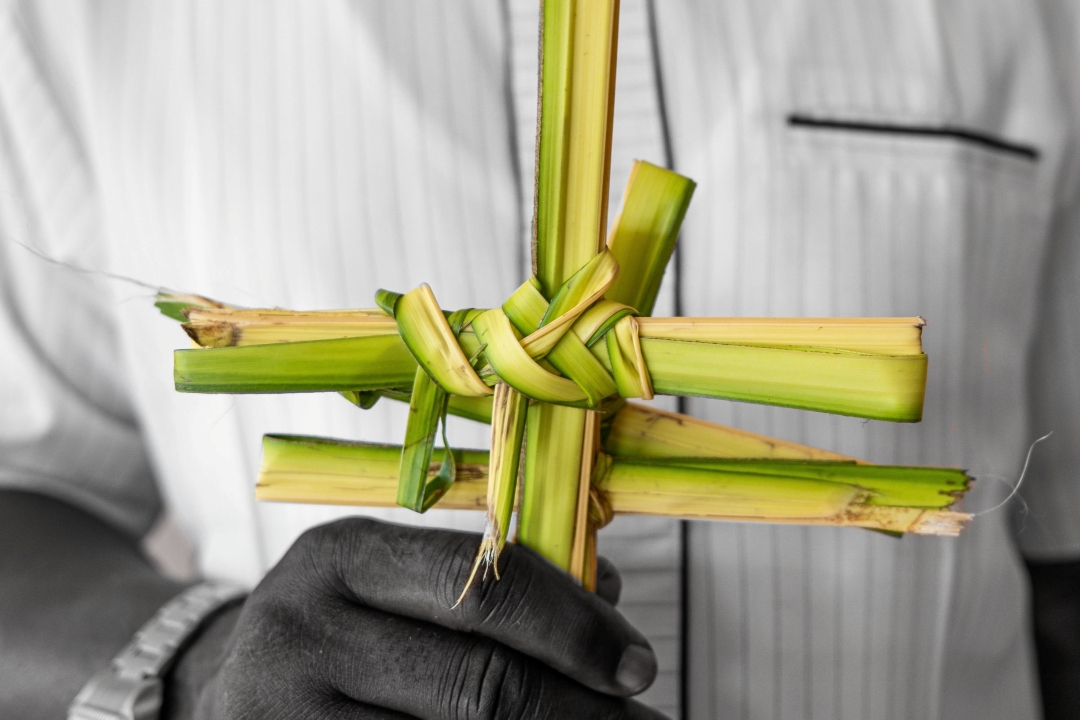
6 Palm Sunday traditions explained
Palm Sunday of the Lord’s Passion marks the beginning of Holy Week, the final week of preparation before the feast of Easter. In the Roman Rite, the celebration of Mass has particular traditions that can make it look different than a typical Sunday Mass.
Many of these traditions are centuries old, with roots in the early Church and based on events described in the Gospels.
The differences are meant to enrich our celebration of Jesus’ Passion, immersing us into the events in a unique way to help our souls ponder the beauty and riches of the Paschal mystery.
Here are 6 of these traditions and their symbolism.
1. Why are palms or other plants used in the procession?
Biblical scholars often translate the branches people used for Jesus’ triumphal entry in generic terms, such as in the Gospel of Matthew, “The very large crowd spread their cloaks on the road, while others cut branches from the trees and strewed them on the road” (Matthew 21:8).
In essence, when palm branches are not available, it is perfectly acceptable to find any type of suitable branch to help commemorate Palm Sunday.
The branches are meant to be a symbolic gesture, symbolizing the need to lay down our hearts before Jesus, allowing him access into our inmost being. This is why, even if you don’t have branches of any sort for your celebration, you can still participate in the spiritual theme of Palm Sunday.
2. Why does the priest wear red?
Red is the color of blood and symbolizes love, fire, passion, and sacrifice. Red is worn on Palm Sunday, Good Friday, on any day related to Jesus’ Passion, on Pentecost, and on the feast days of those who died for the faith (martyrs).
Throughout the Church’s liturgical year, priests wear several different colors of vestments. The colors are not arbitrary but reflect a deeper meaning intended to point us to a specific spiritual theme.
The colors were developed to highlight different spiritual truths according to the day in the Church’s calendar. That way, when someone attended Mass, they could immediately recognize the color and associate it with the season or day that was being celebrated. It led people to a deeper understanding of the faith and reinforced whatever spiritual lessons the Church needed to teach.
3. Why are statues and images veiled?
It seems strange that during the most sacred time of the year, Catholics cover everything that is beautiful in their churches, even the crucifix. Shouldn’t we be looking at the painful scene at Calvary while we listen to the Passion narrative on Palm Sunday?
While it may appear counterintuitive to veil statues and images during the final weeks of Lent, the Catholic Church recommends this practice to heighten our senses and build within us a longing for Easter Sunday. It is a tradition that should not only be carried out in our local parish but can also be a fruitful activity for the “domestic church” to practice.
4. Why is the Gospel reading so long?
For Roman Catholics, the Sunday Mass readings are extremely short compared to the Passion narrative recited (or sung) every year on Palm Sunday. This makes Palm Sunday somewhat challenging for those who have trouble standing for the entire Gospel proclamation.
However, did you know that every Sunday may have been like that in the early Church?
Many of the first Christians were Jewish, and so, not surprisingly, they modeled their liturgy on the synagogue services. This included a continuous reading of Sacred Scripture that was carried on from one week to the next. It was divided up into two separate readings, one from the “Law” and the other from the “Prophets.”
Similarly, early Christians divided up the readings into three separate readings, one from the Old Testament, another from the New Testament Acts or letters, and finally, one from the Gospels.
Yet, the length of each reading was not specified as it is today.
St. Justin Martyr in the 2nd century wrote, “And on the day called Sunday, all who live in cities or in the country gather together to one place, and the memoirs of the apostles or the writings of the prophets are read, as long as time permits; then, when the reader has ceased, the president verbally instructs, and exhorts to the imitation of these good things.”
This means that the recitation of Sacred Scripture varied between Christian communities and was dependent on the bishop who was presiding. If he wanted a long reading, he got one!
Over time the Sunday readings were standardized and specific verses were selected according to the liturgical calendar. The Second Vatican Council in the mid-20th century further refined the practice and returned to the original tradition of three separate readings (for many centuries the Church only had two readings).
If you think “Oh, no, it’s the long Gospel!” at the Palm Sunday liturgy, just remember it could be longer!
5. Why does the congregation participate in the Passion reading?
Holy Week is the most sacred time in the Church’s liturgical calendar, devoted entirely to Jesus’ Passion, death, and resurrection. A recurrent theme throughout the week is a call to accompany Jesus during this most painful part of his life on earth.
Palm Sunday opens Holy Week with a solemn recitation of Jesus’ Passion, typically with each person having a role. When celebrated in a church, the parishioners often take the role of the crowd. This culminates in the entire congregation saying, “Crucify him! Crucify him!” In this instance, we recognize the role our sins have in Jesus’ crucifixion and how Jesus suffered and died for us, even though we weren’t even born yet.
6. What should I do with my blessed palms?
After leaving church on Sunday, you may have come home with several long palm branches from the celebration of Jesus’ triumphant entry into Jerusalem.
You may be asking yourself, “Well, what should I do with these?”
Whatever you do, don’t throw them away!
According to the Code of Canon Law, blessed items are not to be discarded in a trash can but should be treated with respect (cf. #1171). At Mass, these palm branches were set apart by a blessing from the priest and made into a “sacramental,” an object that is meant to draw us closer to the celebration of the seven sacraments. Throwing them in the trash ignores their sacred purpose and treats them like any other object we no longer need.
Instead, the palm branches you bring from church can be used to decorate your house as a reminder of Palm Sunday and Christ’s Passion. The branches can also be dropped off at your parish office or disposed of by burying or burning them. You can learn more here.
Cardinal Tobin will lead the 12:30 p.m. Palm Sunday Mass on March 29 at the Cathedral Basilica of the Sacred Heart, Newark, NJ. You can find the complete Holy Week schedule for 2026 HERE.
This article was written by Philip Kosloski for Aleteia.