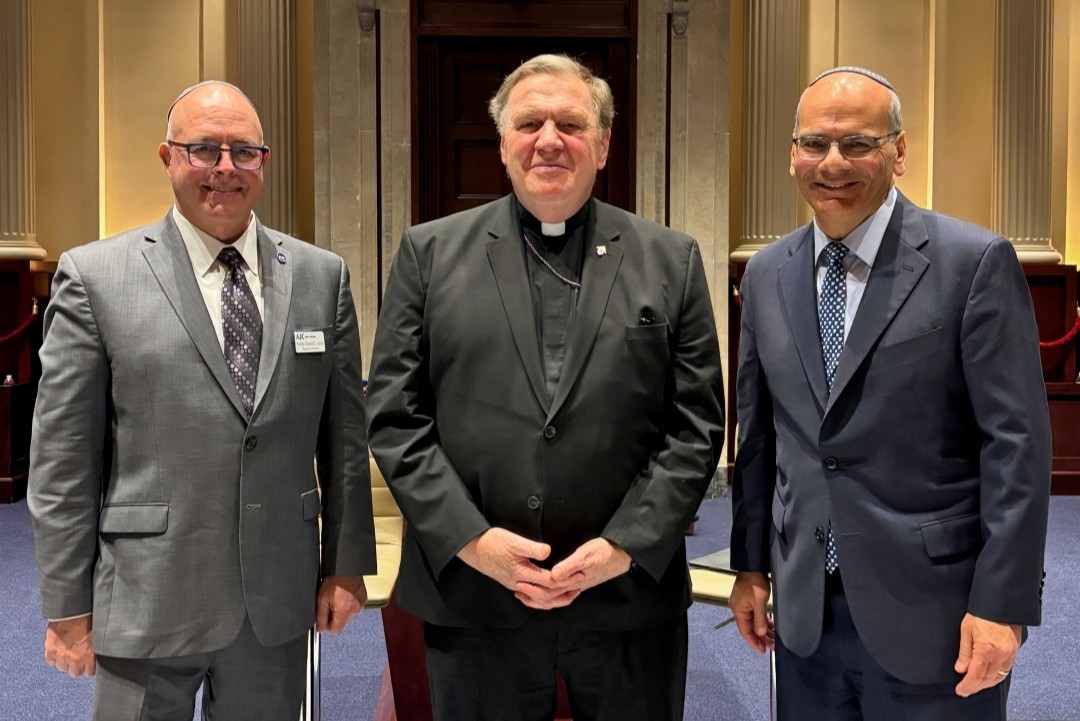
Celebrating Catholic-Jewish Relations 60 Years after Vatican II
Sixty years ago, as the Second Vatican Council neared its conclusion, the ecumenical council released a short but powerful declaration that would change how the Catholic Church related to other religious traditions.
Nostra Aetate, published in 1965, denounced antisemitism and called for greater dialogue between Christians, Jews, and Muslims. “The Church, therefore, exhorts her sons, that through dialogue and collaboration with the followers of other religions, carried out with prudence and love and in witness to the Christian faith and life, they recognize, preserve and promote the good things, spiritual and moral, as well as the socio-cultural values found among these men,” the declaration said.
“It was a revolutionary document, not just for the Catholic Church, not just for Catholic-Jewish relations, but for all interreligious relations,” said Rabbi Noam Marans, Director of Interreligious Affairs for the American Jewish Committee (AJC).
Rabbi Marans sat down with Cardinal Joseph W. Tobin, C.Ss.R., Archbishop of Newark, for a warm, hopeful, wide-ranging conversation that covered not only Nostra Aetate, but also the cardinal’s relationship with Pope Leo XIV, the war in Gaza, and the importance of listening and dialogue.
Nostra Aetate and the call to repentance
“Celebrating Catholic-Jewish Relations and Nostra Aetate 60 Years Later” was co-sponsored by AJC New Jersey and The Sister Rose Thering Fund for Education in Jewish-Christian Studies. The Dec. 3 event, held at Temple Emanu-El in Closter, NJ, was intended to highlight the strength and importance of Jewish-Catholic relations during a period in which acts of antisemitism and religious violence are increasing.
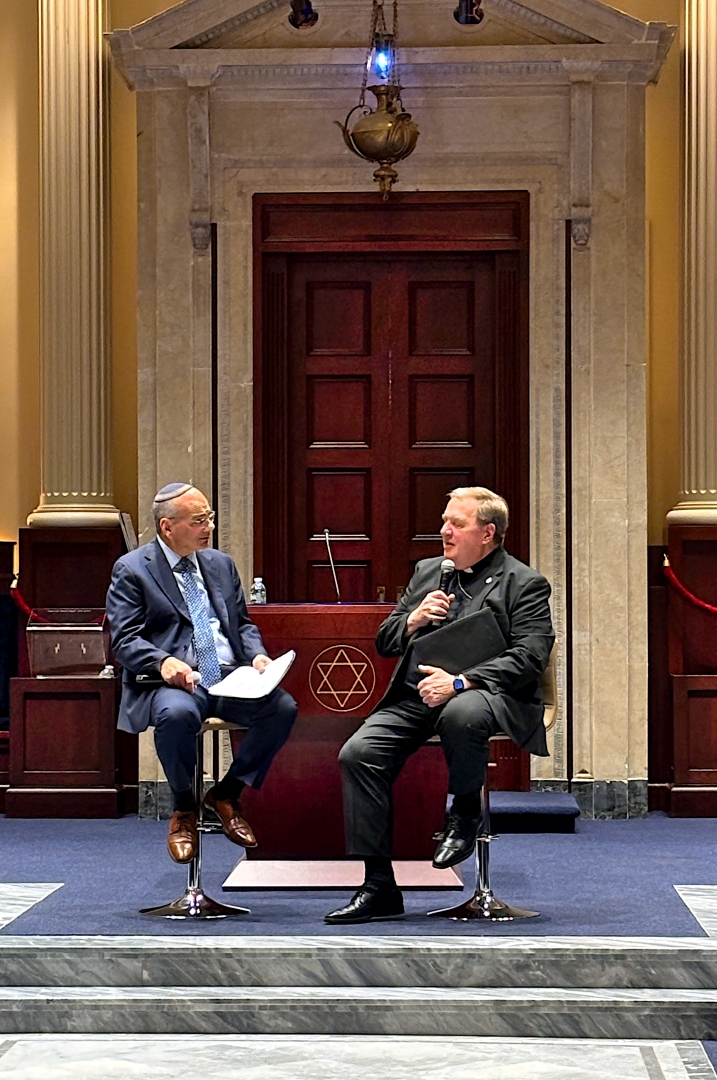 “I don’t think it’s an accident that Nostra Aetate was the last document to come out of the council,” Cardinal Tobin said. “Not because it was the least important, but because it was the document that took the most work.” Cardinal Tobin said that Nostra Aetate was a “call to repentance” that “set the stage for an awakening in the Catholic Church.”
Rabbi Marans also asked Cardinal Tobin about how he first met Pope Leo XIV. Cardinal Tobin said the two met while leading their respective religious orders, the Redemptorists and Augustinians, and worked together frequently over the years. That led to an explanation of Catholic religious orders, communal life, and the vows of poverty, chastity, and obedience that members of orders take.
“I took my vows in ’73 and became a bishop in 2010,” Cardinal Tobin explained. “In that whole time, I didn’t have a bank account.” He said that he hoped to return someday to live in a Redemptorist community after his retirement – “if I’m not run over by a New Jersey transit bus,” he added to much laughter.
Listening and learning
When asked how Nostra Aetate had influenced him, Cardinal Tobin recalled his mother. He explained that she had “led a rather sheltered life” as a Catholic schoolgirl but later developed a strong friendship with a Jewish woman named Golda Levine while teaching in the Detroit public school system. “There were things in the school system that perplexed my mother, and Golda became a kind of godmother to her,” Cardinal Tobin said. “Golda and her husband became great friends of our family.”
According to Cardinal Tobin, the relationship taught him how to “listen and learn.”
Cardinal Tobin also said that the groundwork for Nostra Aetate was first established during Vatican II’s liturgical reforms, which “rediscovered the Jewish foundation for Catholic worship.” He added that popes since Paul VI have continued to teach that spiritual value and truth can be found in other religions, particularly in Judaism.
During the conversation, Rabbi Marans also raised the “tough question” of the war in Gaza and statements Pope Francis made before his death that, to some Jews, implied “a moral equivalency” between Israel and Hamas.
Cardinal Tobin recalled a conversation he had with his father during the Vietnam War, when his father told him that in war “no one has clean hands.”
“That is the ultimate tragedy of war,” the cardinal said, stressing the importance of seeking peace while also continuing to listen and learn.
The only way forward
Rabbi Marans concluded the discussion by emphasizing the importance of ongoing dialogue between Jews and Catholics.
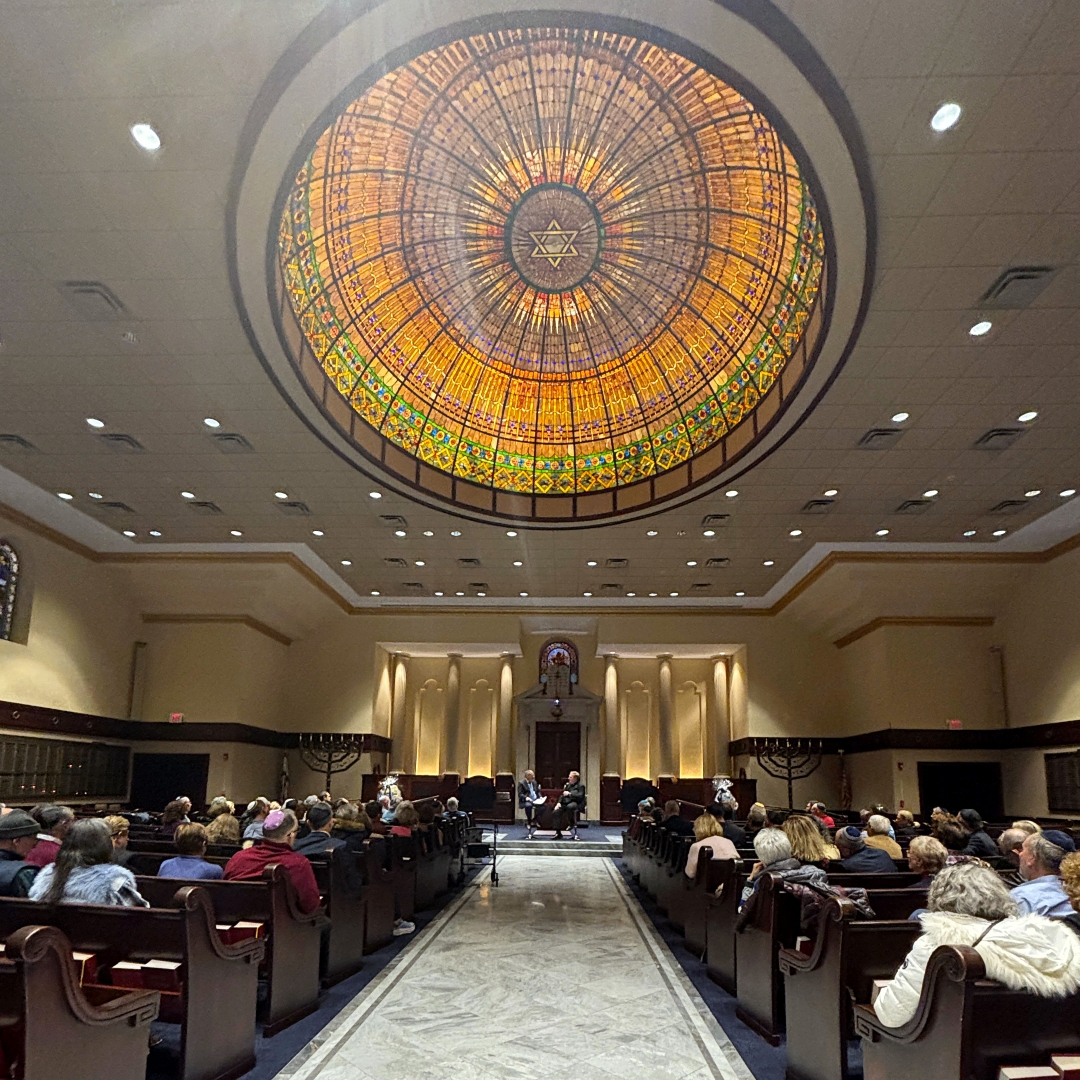 “What does it mean that a rabbi and a cardinal are sitting here in a synagogue in suburban New Jersey having a conversation as if it’s the most normal thing in the world when it’s not?” he asked.
“Well, I think it is the only way forward,” Cardinal Tobin responded.
The cardinal recalled receiving a gift in 2021 from his “good friend,” the American conductor Sir Gilbert Levine, a close collaborator of Pope John Paul II who became known as the “Pope’s Maestro.”
“He handed me this long box, and inside was a conductor’s baton from Vienna,” the cardinal said. “When he gave it to me, he said, ‘This has no voice, but it listens to the voices of others. That’s your job.’”
“And really, that’s how I try to lead my congregation,” Cardinal Tobin concluded. “The most important thing is to listen to other voices and speak with each other, and then God will reveal.”
Long after Rabbi Marans and Cardinal Tobin had concluded their conversation, the Archbishop of Newark remained in the temple, speaking with members of the local Jewish community and answering their questions.
Featured image: Left to right – Rabbi David C. Levy, Regional Director of AJC New Jersey, Cardinal Joseph W. Tobin, C.Ss.R., Archbishop of Newark, and Rabbi Noam Marans, Director of Interreligious Affairs for the American Jewish Committee, gather prior to “Celebrating Catholic-Jewish Relations and Nostra Aetate 60 Years Later” at Temple Emanu-El in Closter, NJ, on Dec. 3, 2025. (Photos by Danielle Cohen / AJC New Jersey)