NJ conference stresses need to accompany those with mental illness
Catholic leaders emphasized to New Jersey’s behavioral health professionals that people with mental illness need compassion and care, and the Christian approach is one of accompaniment, not cure.
Nearly 200 faith leaders and mental health professionals gathered May 2 for the first statewide Catholic Mental Health Conference, centered on the theme “From Isolation to Belonging” and focused on strengthening the connection between faith and mental health. The New Jersey Catholic Conference organized the event.
“Isolation does not have the final word, and belonging is not a luxury or a privilege. It is a Christian responsibility,” said Cardinal Joseph W. Tobin, C.Ss.R., Archbishop of Newark, the principal celebrant at the morning Mass, who also gave opening remarks.
“This conference is an invitation to take that call seriously,” he said. “It invites us to listen with humility, to learn with openness, and to consider how our ministries, institutions, and communities can more faithfully reflect the compassion of Christ for those experiencing mental and emotional suffering.”

“From Witness to With-ness”
Drawing on what he said was personal loss and pastoral experience, Bishop John P. Dolan of Phoenix described loneliness as both a public health and spiritual crisis.
“Presence matters,” he said in his keynote address. “I’ve seen how even simple presence can begin to open a door. Someone shows up, someone stays, someone listens. It does not solve everything, but it begins something.”
He also reflected on the nature of suffering, including suffering by clergy and religious, cautioning that “endurance is not the same as holiness. Suffering in silence is not a sacrifice or a religious virtue.”
Drawing on Pope Leo XIV’s first apostolic exhortation, “Dilexi Te,” Bishop Dolan reflected on Jesus’ words that “the poor will always be with you” and that Christ will remain “until the end of time,” highlighting the Church’s enduring call to compassion and accompaniment.
“When we hear these together … we begin to recognize something: If the poor are always present and Christ is always present, then Christ is encountered among them.”
Bishop Dolan’s words resonated with Deacon Joe Sbarra of St. Anthony of Padua Parish, Hightstown, and Denise Contino, diocesan director of catechesis.
“Bishop Dolan stressed the need for “with-ness” as we minister to those facing mental health challenges,” Deacon Sbarra shared. “To me that means that ‘with-ness’ is Christian witness, as we accompany those to whom we have been sent.”
“As a Church we are called to move from isolation to belonging, because that is at the heart of the Gospel,” Contino said. “Jesus embraced the leper when no one else would; we are called to reach out and help those on the peripheries be a part of our community and let them know we will walk with them.”

The What vs. the Why
In her presentation, “Faith and Mental Health: Understanding the Current Crisis,” Beth Hlabse highlighted how, working together, faith and science can deepen understanding of the human experience and provide practical pathways for care.
Hlabse, program director for the Notre Dame Fiat Program on Faith and Mental Health, said faith and science help explain the “what” and “why” of mental illness, calling the Church to accompany others through compassionate presence.
“The Christian perspective emphasizes that God does not abandon people in suffering but enters into it through Christ. This calls believers to accompany others not by offering quick answers, but through compassionate presence. The Church is described as a healing community, invited to move beyond an ‘us vs. them’ mentality and recognize that all people are vulnerable to suffering.”
She emphasized that “healing doesn’t often mean cure,” but is a movement from isolation to communion.

Accompaniment and Action
Ben Wortham, vice president for behavioral health integration at Catholic Charities USA, told participants that mental health cannot be separated from the broader “social determinants of health,” such as housing, employment, education and family support.
“We can’t talk about mental health without basic needs being met.”
Wortham’s work focuses on integrating mental health care with housing. He also has advanced national programs aimed at reducing chronic homelessness by pairing affordable housing with onsite mental health support.
He highlighted initiatives like Catholic Charities’ Healthy Housing Initiative, which integrates supportive housing with on-site mental health services; partnerships between Catholic hospitals and charities; tools like the “Sister Hope” AI chatbot; and connecting those in need to food assistance, counseling and parish support.
Deacon Ed Shoener, president of the International Association of Catholic Mental Health Ministers, spoke of his daughter Katie, who lived with bipolar disorder, who he lost in 2016. He frames her story in medical terms, “She had a mental illness, and she died from suicide,” and he urged others to recognize mental illness “not as a character flaw … but as an illness.”
He defined mental health ministry as a ministry of accompaniment, not treatment.
“We’re not mental health treatment… we provide spiritual and social support.”
He also emphasized the need for patience and persistence, noting that many conditions are lifelong. He said people need to hear: “It’s good that you exist.”
He encouraged parishes to build awareness and support through education, partnerships with professionals, support groups and naming mental health intentions in the Prayers of the Faithful.
Alejandra Cabria, also of St. Anthony of Padua, said Deacon Shoener’s message was comforting and motivating.
“Deacon Schoener said that I don’t have to have the answers, I am not the healer, God is,” Cabria said.
This article was written by Rose O’Connor for The Trenton Monitor.
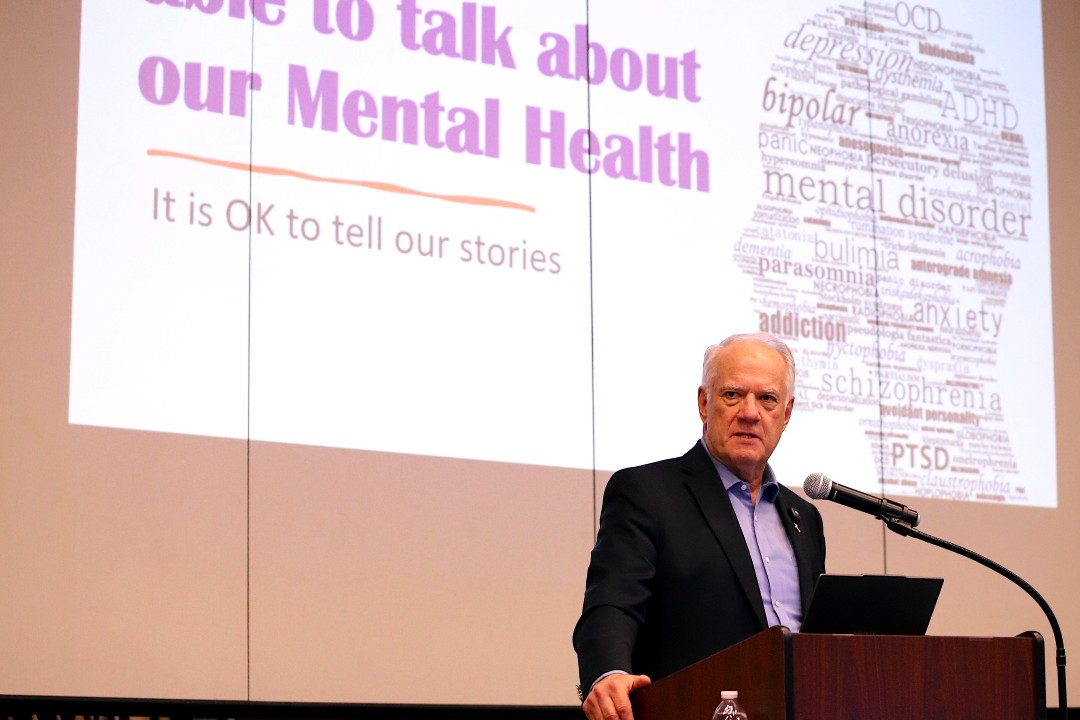
Featured image: Deacon Ed Shoener, founder of the International Association of Catholic Mental Health Ministers, speaks during the New Jersey Catholic Mental Health Conference May 2. (Photo by John Batkowski)